





Description
Product Introduction & Engineering Value
The MTL 8811-IO-DC is designed for safety-oriented discrete signal interfacing in PAC8000 SafetyNet systems. Its eight channels can be configured independently, allowing dry-contact status inputs and DC output functions to coexist within the same module. The module was specified for SIL 2 safety applications and uses non-arcing field circuits for suitable hazardous-area installations.
For maintenance teams, the important point is that this is not simply an interchangeable 24 VDC digital I/O card. The module has a defined A1 key code, specific field-terminal requirements, bussed field-power requirements, and safety-system application constraints. Replacement should therefore be based on the complete PAC8000/SafetyNet configuration rather than voltage and channel count alone.
Technical Specifications
| Specification | 8811-IO-DC |
|---|---|
| Module type | 24 VDC non-isolated discrete I/O |
| Number of channels | 8 |
| Channel configuration | Independently configurable as input or output |
| Input application | Dry-contact switches |
| Typical ON/OFF threshold current | 0.9 mA |
| Typical wetting current | 1.2 mA |
| Typical open-circuit voltage | 24 VDC, dependent on bussed field power |
| Minimum detected input pulse | 5 ms |
| Maximum input frequency | 30 Hz in pulse-counting mode without debounce |
| Input filter | 0–8 s, adjustable in 1 ms increments |
| Input functions | Latching, pulse counting, line-fault detection |
| Output current | 2 A maximum per channel |
| Continuous output current | 6 A maximum per module |
| Non-continuous output | 8 A maximum for less than 10 s |
| Output modes | Pulse, discrete, pattern |
| Output pulse width | 1 ms–60 s |
| Output response | 1 ms maximum |
| Input response | 5 ms maximum |
| Channel-to-Railbus isolation | 250 VAC |
| Field circuit type | Non-arcing / non-incendive |
| System power | 50 mA typical, 70 mA maximum |
| Bussed field power | 24 VDC required |
| Module width | 42 mm |
| Module weight | Approximately 210 g |
| Module key code | B6 in one current reproduced specification; verify the installed revision before replacement |
The core electrical specifications above come from the reproduced GE Automation & Control product specification. One secondary copy shows a conflicting A1 key-code entry for the same module, while another technical reproduction identifies B6; because key coding is installation-critical, the physical module and current system documentation should be checked before procurement.
Important Power-Supply Detail
The 8811-IO-DC requires 24 VDC bussed field power from the 8914-PS-AC according to the SafetyNet documentation. This should not be confused with the module’s system-side 12 V rail supply.
Field Application & Trench Experience
A typical 8811-IO-DC replacement occurs in a PAC8000 SafetyNet node where a combination of discrete feedback and discrete control signals must remain available after an I/O fault. Because each channel can be configured independently, a single module may handle dry-contact status signals on some channels and output functions for valves, solenoids, or alarms on others.
A practical maintenance issue is total output loading. The module permits up to 2 A on an individual output channel, but the continuous module limit is 6 A. Therefore, checking only the current rating of the individual channel can produce an incorrect load calculation when several outputs operate simultaneously.
Typical Application Scenarios
- Safety instrumented systems: Discrete status monitoring and control within SafetyNet SIL 2 architectures.
- Emergency shutdown functions: Monitoring dry contacts and controlling discrete shutdown-related devices.
- Process alarms and valve control: Switching DC loads such as alarms, solenoids, and valves where the module’s output limits are satisfied.
- Hazardous-area process plants: Non-arcing field-circuit applications in appropriately classified safe or hazardous areas.
QA & Testing SOP
For a New Surplus 8811-IO-DC, inspection should establish both the physical condition and the exact module configuration.
Recommended Incoming Inspection
- Verify the complete 8811-IO-DC part marking.
- Record the serial number, date code, revision, and any configuration labels.
- Inspect the enclosure and connector interface for cracks, bent contacts, or contamination.
- Check the module keying against the intended PAC8000 carrier configuration.
- Verify the eight channel indicators and front-panel condition.
- Check that the module corresponds to the required SafetyNet application.
- Confirm the required field-terminal arrangement from the current system documentation.
- Verify the 24 VDC bussed field-power requirement.
- Perform controlled input/output tests where suitable test equipment is available.
- Record channel response, output switching, diagnostics, and fault indications before shipment.
New Surplus note: “New Surplus” describes inventory condition. It should not automatically be represented as recently manufactured, factory-tested, or currently supported by the original manufacturer unless those claims are documented for the specific unit.
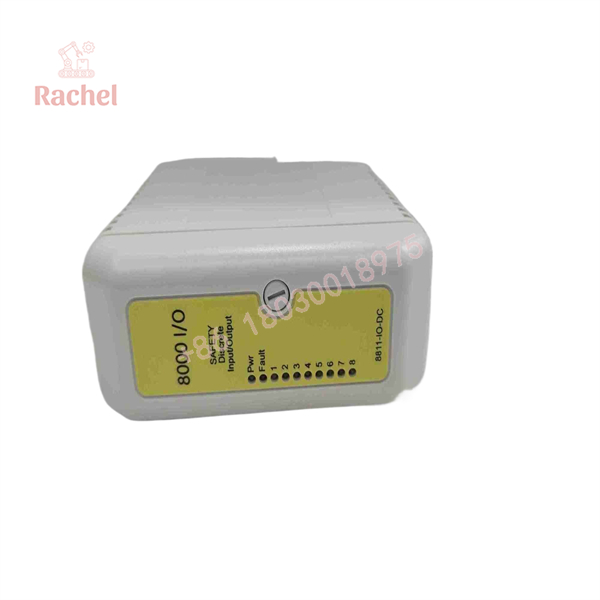
8811-IO-DC
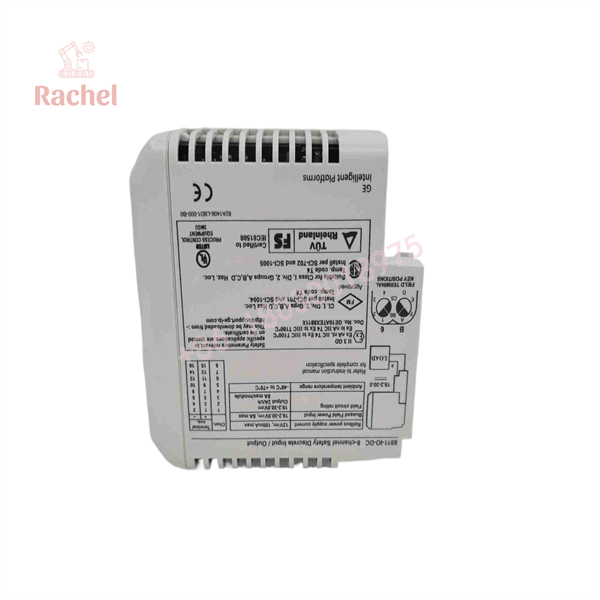
8811-IO-DC
Veteran’s Tech Trap Guide
Trap 1 — Confusing 8811-IO-DC with a conventional 8-channel DI module
The 8811-IO-DC is a combination discrete I/O module. Its eight channels can independently operate as inputs or outputs. It is not equivalent to a fixed 8-channel digital-input card.
Pro tip: Check the original application configuration before substituting another PAC8000 discrete module.
Trap 2 — Looking only at the 2 A channel rating
The module can switch up to 2 A per output channel, but continuous output loading is limited to 6 A for the complete module. Several high-current outputs operating simultaneously therefore require a module-level load calculation.
Trap 3 — Mixing up system power and bussed field power
The module uses the PAC8000 system rail while also requiring 24 VDC bussed field power for its field circuits. These are separate power functions.
Trap 4 — Ignoring keying and terminal compatibility
PAC8000 modules use mechanical keying and defined field-terminal arrangements. A module that appears electrically similar may still be unsuitable for the existing carrier configuration. The documentation identifies specific key codes and compatible terminal arrangements.
FAQ
What is MTL 8811-IO-DC?
The 8811-IO-DC is a PAC8000 SafetyNet 8-channel discrete input/output module. Each channel can be independently configured as an input or output. It was designed for safety applications and is documented for SIL 2 use.
Is 8811-IO-DC a digital input or digital output module?
It is both. The eight channels are individually configurable as inputs or outputs. Inputs are intended for dry-contact applications, while outputs can operate in discrete, pulse, or pattern modes.
What is the output current of 8811-IO-DC?
The maximum output current is 2 A per channel. The continuous output limit for the complete module is 6 A, with up to 8 A permitted for less than 10 seconds under the specified conditions.
Does 8811-IO-DC support line-fault detection?
Yes. The module documentation specifies configurable line-fault detection, including open-circuit and open-and-short-circuit detection functions depending on the channel configuration.
What is the response time?
The documented maximum response is 5 ms for an input signal becoming available on the Railbus and 1 ms from a Railbus command to an output change. Actual system response also depends on the overall control architecture and configuration.
Can 8811-IO-DC be used in hazardous areas?
The module is documented with non-arcing/non-incendive field-circuit protection concepts and certification for appropriate hazardous-area applications, including Class I, Division 2 and Zone 2 applications under the applicable certification conditions. The MTL certification documentation lists the 8811-IO-DC under Ex II 3 GD / Ex nA nL IIC T4 Gc and related protection markings.
Is 8811-IO-DC still available from the manufacturer?
Availability and lifecycle status require care. Some current secondary-market listings identify the part as discontinued, while a reproduced technical specification labels its lifecycle status active. Because these sources conflict, procurement should verify the status against the specific installed PAC8000/SafetyNet revision rather than relying on a reseller’s lifecycle statement.
Can New Surplus 8811-IO-DC be used as a replacement?
A New Surplus unit can be considered if its part number, revision, keying, condition, and application compatibility are verified. For a safety-system replacement, perform the required proof testing, configuration verification, and safety-system procedures before returning the affected loop to service.

 Start Chat


