





Description
Product Introduction
The Pacific Scientific 33VM52-000-29 is a low-inertia permanent-magnet DC servo motor intended for industrial motion-control applications. It belongs to the 33VM series and is documented with a 24 VDC rating, 6.4 A RMS current, and Alnico V-7 magnet material.
This is an old-school servo motor. There is no integrated optical encoder or analog tachometer listed for this configuration, so the feedback architecture must be considered at the machine level. Its low-inertia rotor makes it useful where rapid acceleration and deceleration matter more than simply producing large continuous torque.
Key Technical Specifications
| Parameter | Specification |
|---|---|
| Manufacturer | Pacific Scientific |
| Part Number | 33VM52-000-29 |
| Product Family | 33VM Low Inertia PMDC Servomotors |
| Motor Type | Permanent-Magnet DC Servo Motor |
| Rated Voltage | 24 VDC |
| Rated Current | 6.4 A RMS |
| Published Current Range | 3.1-5.7 A continuous in one catalog reference |
| Torque Constant | 5.9 oz-in/A |
| Terminal Resistance | 0.85 Ω |
| Rotor Inertia | 0.00043 oz-in-sec² |
| Magnet Material | Alnico V-7 |
| Cooling | No provision for forced-air cooling |
| Analog Tachometer | None attached |
| Optical Encoder | None attached |
| Shaft Diameter | Approximately 0.281-0.344 in drive-end bearing journal |
| Lifecycle | Discontinued / obsolete |
There is an important discrepancy in available references: one industrial listing gives 6.4 A and 24 VDC, while another catalog-derived source lists 3.1-5.7 A continuous and 18-36 V. Treat the motor nameplate and original Pacific Scientific documentation as authoritative for the particular unit.
Application Scenarios & The “Trench” Experience
The failure usually does not happen at a convenient time. A 30-year-old machine loses one axis, the servo amplifier still appears healthy, and someone discovers that the original DC motor is no longer in normal distribution. Now the question is not “What motor is cheapest?” It is “What motor can reproduce the original electromechanical behavior without redesigning the axis?”
- Machine Tools — Feed-Axis Motion — Low rotor inertia helps the servo amplifier accelerate and decelerate the axis quickly.
- EDM Equipment — Precision Axis Drive — The exact model is documented as having been removed from a Mondo Star EDM machine, making this a particularly relevant legacy application. ([turn0search0]
- Packaging Machinery — Indexing Motion — Suitable for repeated start-stop positioning where low inertia reduces the mechanical burden on the servo loop.
- Small Automation Machines — Speed/Position Control — Applicable where a low-voltage PMDC motor is already integrated with a compatible servo amplifier and feedback system.
- Legacy Motion Systems — Obsolete Motor Replacement — Useful when maintaining the original amplifier, mechanics, and electrical architecture is preferable to a complete servo conversion.
Field case — plausible replacement scenario:
A legacy EDM axis begins losing position during rapid moves. The amplifier checks out. The mechanical coupling is intact. The technician eventually isolates the problem to the DC servo motor.
The nameplate reads 33VM52-000-29.
A modern AC servo could replace the axis, but that means changing the amplifier, feedback interface, mounting arrangement, tuning, and potentially the machine controller. A tested matching motor is considerably less disruptive. After checking winding resistance, insulation condition, shaft runout, and unloaded operation, the replacement motor is installed and the original servo loop is retuned.
The machine is back in production without turning a motor failure into a controls modernization project.
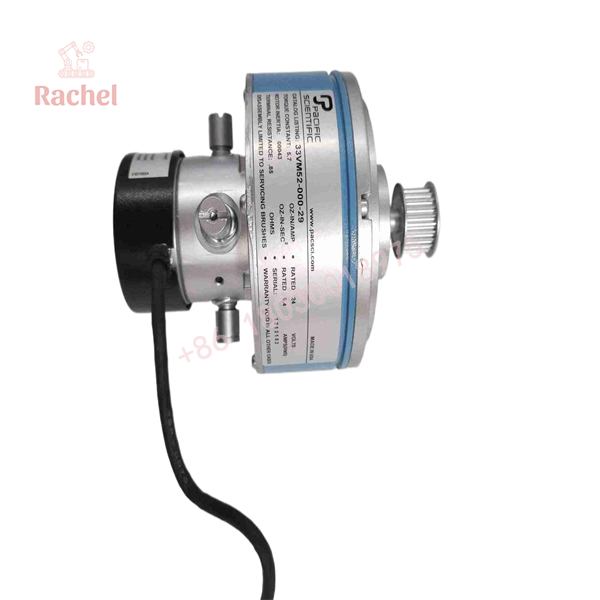
33VM52-000-29
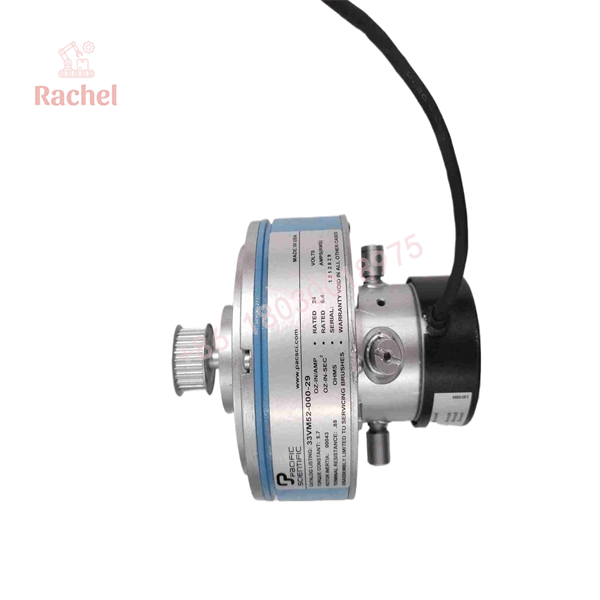
33VM52-000-29
Transparency SOP: Quality Assurance & Testing
For an obsolete DC servo motor, electrical and mechanical testing both matter.
- Inbound Inspection
- Verify the 33VM52-000-29 nameplate and serial information.
- Inspect the shaft, bearings, mounting face, terminals, housing, and cable interface.
- Look for evidence of overheating, impact damage, corrosion, or rewinding.
- Live Rig Testing
- Operate the motor using an appropriately rated DC servo amplifier.
- Verify smooth starting, acceleration, deceleration, and reversal.
- Check for abnormal vibration, brush noise, commutation problems, or excessive current.
- Do not connect it directly to an uncontrolled 24 VDC supply for functional testing.
- Electrical Parameter Checks
- Measure winding/terminal resistance.
- Check insulation resistance using a test procedure appropriate for the motor and amplifier interface.
- Compare current draw under controlled mechanical load.
- Verify that no abnormal heating develops during the test period.
- Feedback Verification
- This exact configuration is listed without an attached optical encoder or analog tachometer.
- Verify whether the machine uses external feedback before assuming the motor itself supplies velocity or position feedback.
- Final QC & Anti-static Packaging
- Record serial number, resistance measurements, and test results.
- Inspect the shaft and mounting surfaces again after testing.
- Protect the motor against mechanical shock and contamination during shipment.
We don’t just ship boxes. A legacy servo motor should be electrically and mechanically tested before it is trusted on a precision machine axis.
The Veteran’s Tech Trap Guide (Crucial Value-Add)
- ⚠️ Do not assume 24 VDC means “connect it to 24 volts and see what happens.” This is a servo motor. The amplifier controls current, acceleration, and braking. Use the correct servo amplifier and current limits.
- ❗ Check the feedback architecture before ordering. The 33VM52-000-29 is documented without an attached optical encoder or analog tachometer. If your existing motor has an external tachometer, resolver, encoder, or other feedback device, document that separately.
- ⚠️ Measure the winding before installation. A resistance measurement that differs materially from the removed motor can indicate winding damage or a different motor configuration. One published reference gives approximately 0.85 Ω terminal resistance.
- ❗ Watch the brushes and commutator. This is a brushed PMDC motor. Excessive sparking under load is not something to “run through.” Stop and investigate the commutator, brushes, current limit, and mechanical load.
Frequently Asked Questions (FAQ for Conversion)
Q1. What is Pacific Scientific 33VM52-000-29?
It is a 33VM-series low-inertia permanent-magnet DC servo motor. Industrial references identify it as a Pacific Scientific motor used in legacy motion-control equipment.
Q2. Is the 33VM52-000-29 discontinued?
Yes. Current industrial references identify the motor as discontinued, and a catalog-derived listing explicitly states “obsolete no replacement.”
Q3. What are the motor’s voltage and current ratings?
The strongest part-specific references identify 24 VDC and 6.4 A, while a broader 33VM catalog entry gives an 18-36 V range and 3.1-5.7 A continuous rating. Because those figures conflict, verify the actual nameplate before selecting the servo amplifier or replacement motor.
Q4. Does this motor have an encoder?
The 33VM52-000-29 catalog information lists no attached optical encoder and no analog tachometer. That does not prove that the machine lacks feedback; the original machine may use an external feedback device.
Q5. Can I replace it with a modern AC servo motor?
Technically, yes, but it is a system conversion rather than a direct replacement. You may need a new servo amplifier, feedback interface, motor mounting arrangement, cabling, controller configuration, and tuning procedure. For an operating legacy machine, an exact motor replacement is usually much less invasive.
Q6. Is it hot-swappable?
No. A servo motor is not a hot-swappable component. Isolate the servo amplifier, discharge the DC bus according to the drive manufacturer’s procedure, and mechanically secure the axis before disconnecting the motor.
Q7. Is a surplus 33VM52-000-29 fake or refurbished?
Not necessarily. The model is obsolete and is now commonly found through secondary industrial channels. Some suppliers explicitly offer new-surplus or refurbished inventory, while other listings are used equipment.

 Start Chat


