





Description
Product Introduction
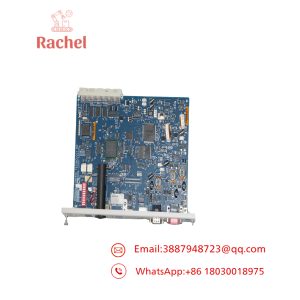
The Rolls-Royce CCN 01 (often designated as the CANman Controller Network Board) serves as the primary processing layer within legacy Rolls-Royce Marine, Kamewa, and Ulstein propulsion control architectures. Designed specifically to handle real-time marine automation, this card coordinates critical command loops between bridge levers, local thruster processors, and power management networks.
Unlike generic industrial gateways, the CCN 01 runs specialized marine firmware engineered to execute low-latency data handshakes across high-density CAN loops. It offloads complex fieldbus routing from central alarm and monitoring units, preventing packet collisions and maintaining pitch control stability during heavy maneuvering.
Key Technical Specifications
| Parameter | Specification |
|---|---|
| System Architecture | Rolls-Royce / Ulstein CANman Control System |
| Network Protocol | High-Speed CAN Bus (CANopen / J1939 compatibility layer) |
| Baud Rate | Up to 1 Mbit/s (Standard Marine CAN) |
| Power Input | 24 VDC Nominal (Dual/Redundant Power Support) |
| Isolation | 1.5 kV Galvanic Bus Isolation |
| Hardware Form Factor | Multi-slot rack-integrated Eurocard PCB with backplane pin headers |
| Operating Temperature | -25°C to +70°C (-13°F to 158°F) |
| Associated Fieldbus Nodes | Rolls-Royce SLIO 01, SLIO 02, Kamewa SLIO 01 |
| Mounting Style | Sub-rack chassis slot with front retaining thumbscrews |
| Net Weight | ~370 grams (0.81 lbs) |
Application Scenarios & The “Trench” Experience
It’s 02:00 during DP (Dynamic Positioning) operations off an offshore rig, and the bridge alarm panel flashes a loss of thruster response on Azimuth 2. A voltage transient in the engine control room roasted the onboard CAN transceiver on the primary CCN 01 board inside the CANman rack. In maritime automation, you don’t have the luxury of re-engineering a bridge console at sea—you need an identical, functional replacement card to restore communication before your vessel gets kicked off station.
Specific Applications:
- Kamewa Waterjets & Thrusters: Coordinates pitch feedback, steering angle signals, and hydrodynamic actuator control loops.
- Marine Power Management Systems (PMS): Interfaces local generator control nodes to central telemetry rings over redundant CAN lines.
- Integrated Propulsion Control Rings: Relays real-time throttle and azimuth commands from bridge telegraphs down to local sub-rack I/O.
Field Case Study:
A 180-foot offshore supply vessel experienced intermittent command dropouts on its bow thruster during dock docking maneuvers. Diagnostics traced the fault to thermal micro-cracking on an older Rev A CCN 01 board. Harbor authorities threatened to ground the vessel until the thruster control loop passed inspection. Technicians swapped the failing card with a bench-tested Rev. B CCN 01 unit, set the DIP switch node address, and completed full pitch-loop calibration within two hours—avoiding tens of thousands in vessel charter penalties.
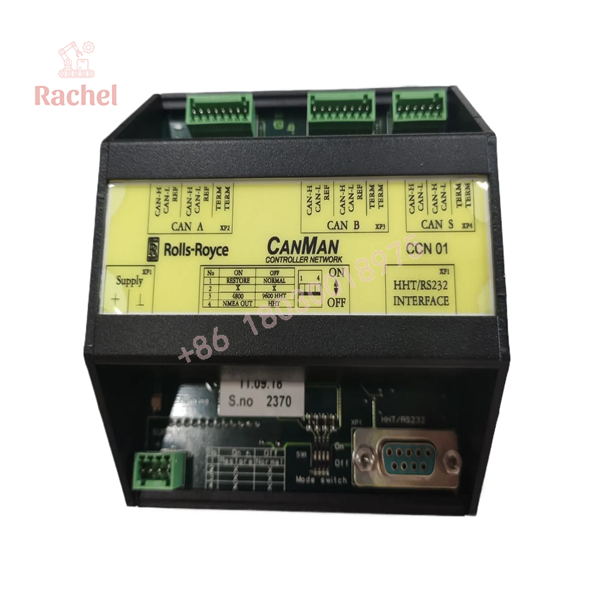
CCN 01
Transparency SOP: Quality Assurance & Testing
We test our surplus maritime hardware on functional racks to ensure drop-in reliability. Here is our technical testing workflow for the Rolls-Royce CCN 01:
- Inbound Visual & Pin Integrity Audit: Detailed check under magnification for bent backplane edge pins, trace corrosion, saltwater oxidation, or thermal stressing on components.
- Galvanic & Power Stage Check: Insulation testing across power inputs and signal paths to verify the 1.5 kV isolation barrier is intact.
- Sub-rack Power-On Diagnostics: Card inserted into a test backplane to monitor boot cycles, voltage regulator stability, and board-level health LEDs.
- Active CAN Bus Loop Traffic Testing: Card connected to a CAN analyzer running simulated SLIO 01/02 node telemetry to verify zero packet drops or frame errors at 1 Mbit/s.
- Conformal Coating & Anti-Static Packing: Board cleaned, verified for marine environment sealing, and stored in heavy-duty ESD shielding bags.
The Veteran’s Tech Trap Guide
⚠️ Verify Your Hardware Revision Level! Pay close attention to whether your system requires Revision A or Revision B. While Rev B cards feature hardened surface-mount components designed for higher vibration resistance, double-check board layout and hardware jumpers against your schematic to prevent backplane pin misalignments.
❗ Match the Rotary DIP Switch Node Addresses Exactly! Before sliding the replacement card into the sub-rack, check the hardware node address switches on the PCB board. If you drop a replacement CCN 01 into slot 1 with the wrong node ID address set, it will conflict with other CANman loop controllers or fail to register on the UMAS-V panel entirely. Photograph the old board’s DIP switches before removing it.
⚠️ Inspect Backplane Rail Alignments Before Pushing! Do not force the card into the chassis slot. Marine sub-racks can accumulate dust and salt residue in the nylon guide tracks. Forcing the card home with misaligned guide rails will bend or snap the rear edge-connector pins, destroying the backplane.
Frequently Asked Questions (FAQ)
Q: Is the Rolls-Royce CCN 01 hot-swappable? A: While the mechanical rack supports slide insertion, you should always power down the localized sub-rack power rails before pulling or inserting the card. Inserting the card live risks voltage arcing across signal ground pins, which can corrupt live CAN traffic on adjacent modules.
Q: Do I need to program logic into a replacement CCN 01 card? A: In most CANman deployments, application logic and loop parameters are pushed from central system memory or configured via node jumpers. However, you must ensure the board’s firmware revision matches your operating system architecture to maintain bus parity.
Q: Can this module directly replace a standard CANopen gateway? A: No. The CCN 01 is a proprietary controller board built specifically for Rolls-Royce Marine, Kamewa, and Ulstein CANman automation systems. It is not a generic off-the-shelf industrial gateway.
Q: Why use pre-tested surplus instead of upgrading the bridge control system? A: Upgrading a vessel’s entire propulsion control architecture requires Class approval (e.g., DNV, ABS, Lloyd’s), custom panel fabrication, and weeks of shipyard downtime costing hundreds of thousands of dollars. A direct card swap restores the existing type-approved system immediately.
Q: What warranty is provided with this surplus board? A: Every pre-tested Rolls-Royce CCN 01 card is backed by a full 12-month replacement warranty covering component failure and bus communication defects.

 Start Chat


