





Description
Product Introduction & Engineering Value
The 140AVI03000 is built for mixed analog measurement duties where a Quantum rack needs several voltage or current inputs without dedicating separate modules to each signal type. Each of its eight channels can handle selectable analog ranges, including standard 4–20 mA process signals and bipolar voltage inputs.
This flexibility is useful in legacy process installations. One channel can monitor a 4–20 mA transmitter while another handles a ±10 V signal, provided the channels are configured correctly. The module is now discontinued, so exact-match surplus and refurbished inventory remain relevant for plants maintaining existing Quantum hardware. Schneider lists BMXAMI0810 as the recommended replacement.
Technical Specifications
| Specification | 140AVI03000 |
|---|---|
| Platform | Modicon Quantum |
| Module Type | Analog input |
| Number of Channels | 8 |
| Input Configuration | Differential |
| Addressing Requirement | 9 input words |
| Current Inputs | ±20 mA, 0–20 mA, 4–20 mA |
| Voltage Inputs | ±10 V, ±5 V, 0–10 V, 0–5 V, 1–5 V |
| Resolution | Up to 16 bits |
| Maximum Input | 50 VDC / 25 mA |
| Current Input Impedance | 250 Ω ±0.03% |
| Voltage Input Impedance | >20 MΩ |
| Linearity Error | ±0.008% |
| Typical Accuracy | ±0.03% |
| Maximum Accuracy Error | ±0.05% of full scale |
| Temperature Drift | Typical ±0.0015% FS/°C |
| Update Time | 10 ms |
| Common-Mode Rejection | >80 dB at 60 Hz |
| Channel-to-Bus Isolation | 500 Vrms AC for 60 seconds / 750 VDC |
Schneider’s published data confirms the module’s eight differential inputs, multirange operation, 16-bit resolution, 50 VDC/25 mA absolute maximum inputs, and specified accuracy characteristics.
Input Range Detail
The 140AVI03000 supports substantially more than a basic 4–20 mA input card:
- Current: ±20 mA, 0–20 mA, 4–20 mA
- Voltage: ±10 V, ±5 V, 0–10 V, 0–5 V, 1–5 V
- Signal type: Differential
- Filter: Single-pole low-pass, approximately 847 Hz at -3 dB
The older Quantum documentation also identifies a broken-wire indication for 4–20 mA inputs, which is particularly useful when diagnosing field transmitter circuits.
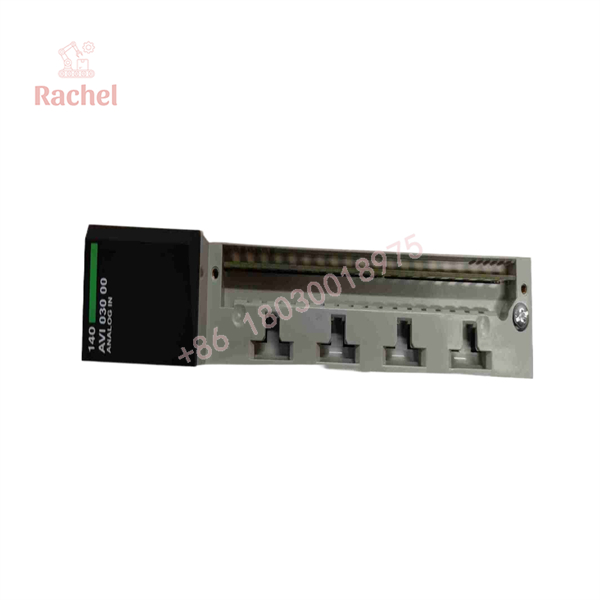
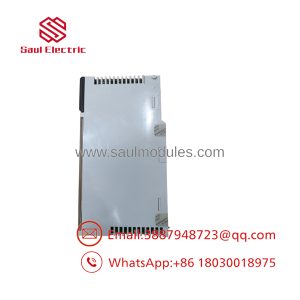
140AVI03000
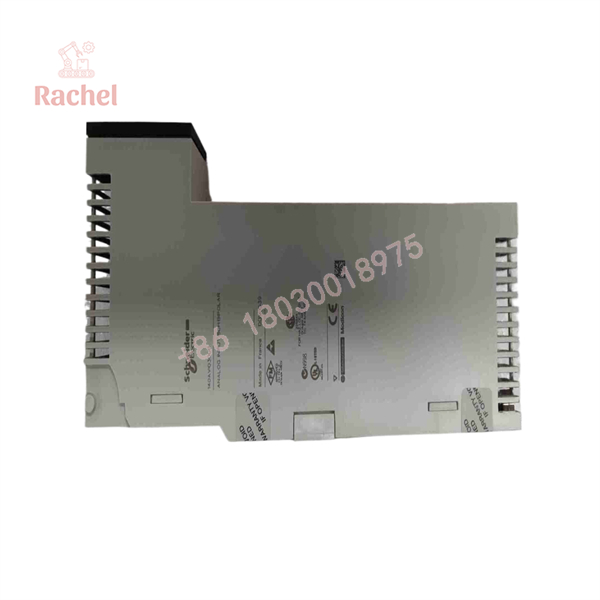
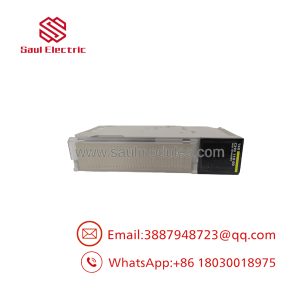
140AVI03000
Field Application & the “Trench” Experience
Picture a legacy chemical-processing skid with a Quantum PLC controlling several temperature, pressure, and flow loops. The PLC continues executing normally, but one section of the operator display suddenly shows implausible process values. The maintenance team checks the transmitter first. Its 4–20 mA output is correct.
The signal is reaching the cabinet, but the PLC value is wrong.
A channel-level check eventually points toward the 140AVI03000. Instead of replacing the entire Quantum rack, the maintenance team installs a verified spare, checks the channel configuration, measures the actual loop current, and confirms the engineering-unit scaling before putting the loop back into automatic control.
That distinction matters: an analog input fault is not necessarily a transmitter fault.
Niche Application Scenarios
- 4–20 mA pressure transmitters on compressor or pump discharge monitoring.
- ±10 V valve-position feedback from legacy electrohydraulic actuators.
- 0–10 V process analyzers integrated into Quantum-based control cabinets.
- Mixed process instrumentation racks where voltage and current signals must coexist on the same Quantum analog-input module.
Transparency SOP: QA & Testing
For new-surplus or refurbished inventory, the receiving inspection should focus on both the electronics and the analog measurement performance.
Part identification: Verify the complete 140AVI03000 reference and inspect the module label and revision markings.
Physical condition: Examine the front connector, backplane connector, housing, terminal interface, LEDs, and PCB for damage, contamination, corrosion, or signs of previous repair.
Electrical verification: Test representative voltage and current input ranges. A meaningful test should include at least one 4–20 mA point and one voltage range rather than simply checking whether the module powers up.
Channel verification: Where suitable test equipment is available, exercise all eight channels and verify that the PLC receives the expected raw values.
Configuration verification: Confirm that the software configuration matches the actual field signal. A correctly functioning module can still produce incorrect process values when the channel range is configured incorrectly.
For new-surplus stock, unused does not necessarily mean recently manufactured. The 140AVI03000 is a discontinued product, so date codes, storage history, packaging, and actual-unit photographs are worth documenting before purchase. Schneider’s current product page confirms its discontinued status.
The Veteran’s Tech Trap Guide
⚠️ Trap #1 — Confusing 140AVI03000 with a simple 4–20 mA card
It is not. The module accepts multiple voltage and current ranges. That flexibility creates configuration responsibility. Verify the input range channel by channel.
⚠️ Trap #2 — Forgetting the differential input architecture
The 140AVI03000 uses differential inputs. Do not automatically copy the wiring approach from a single-ended analog module. The older Quantum documentation specifically notes wiring considerations for current inputs, including jumpers between input and sense terminals.
PRO TIP: Before removing the old module, photograph every analog channel and record the configured range. This is especially valuable when several transmitters use different signal types.
⚠️ Trap #3 — Treating BMXAMI0810 as a mechanical drop-in
Schneider recommends the BMXAMI0810 as the replacement for the 140AVI03000. However, it belongs to the Modicon X80 platform. A replacement strategy therefore requires an architecture and configuration review rather than assuming a direct Quantum-rack substitution.
⚠️ Trap #4 — Checking only the LED status
A module can be powered and communicating while still producing an incorrect analog value. For a suspected analog-input problem, inject a known calibrated signal and compare the raw PLC value against the expected range.
Dynamic FAQ
What is the Schneider Electric 140AVI03000?
It is an 8-channel multirange analog input module for the Modicon Quantum platform, with differential inputs supporting both voltage and current signals.
Does the 140AVI03000 support 4–20 mA?
Yes. It supports 4–20 mA, along with 0–20 mA and ±20 mA current ranges. It also supports several voltage ranges, including ±10 V and 0–10 V.
What resolution does it provide?
The module provides up to 16-bit resolution, depending on the selected input range. Schneider documentation specifies 16-bit operation for several voltage and current ranges.
Is the 140AVI03000 discontinued?
Yes. Schneider Electric lists the reference as discontinued and gives December 31, 2030 as the end-of-service date on its U.S. product page. Exact discontinuation dates vary by Schneider regional site.
What is the recommended replacement?
Schneider identifies the Modicon X80 BMXAMI0810 as the replacement. Because it belongs to the X80 platform rather than Quantum, migration should be engineered rather than treated as a simple plug-in substitution.
Is New Surplus 140AVI03000 still available?
Yes, aftermarket suppliers continue to list new and refurbished units, although availability is inventory-dependent. Because the OEM part is discontinued, verify that a claimed New Surplus unit is unused original inventory and request photographs of the actual label, packaging, and revision/date markings before purchase.
What warranty should I expect?
Warranty depends on the seller and stock condition. OEM lifecycle status and an aftermarket supplier’s warranty are separate matters. For refurbished or surplus 140AVI03000 units, the quotation should explicitly state warranty duration, test status, return terms, and whether the photographed unit is the unit being shipped.

 Start Chat


