





Description
Product Introduction & Engineering Value
The important distinction with the 140CRP93200 is its head-end position. It belongs on the controller-side Quantum rack; the corresponding remote I/O adapter belongs on the remote drop. The module has two RIO channels and supports redundant coaxial cabling, making it applicable to Quantum S908 architectures where network availability matters.
This is a legacy part. Schneider lists the 140CRP93200 as discontinued, with end of commercialization in 2022 and end of standard service scheduled for December 31, 2029 in its U.S. listing. Schneider’s UK product page states that it has not been replaced.
Technical Specifications
| Parameter | Specification |
|---|---|
| Catalog Number | 140CRP93200 |
| Product Family | Modicon Quantum |
| Module Type | RIO head-end adapter |
| RIO Channels | 2 |
| Network | S908 Remote I/O |
| Cable | 75 Ω coaxial |
| Transmission Rate | 1.544 Mbit/s |
| Dynamic Range | 35 dB |
| Maximum Drops per Network | 31 |
| I/O Words per Drop | 64 input / 64 output |
| Isolation Voltage | 500 VDC, coaxial center to ground |
| Electrical Connection | 2 female F-type connectors with redundant cable |
| Bus Current | 750 mA |
| Power Dissipation | 3 W |
| Operating Temperature | 0–60°C |
| Storage Temperature | -40–85°C |
| Relative Humidity | 95% non-condensing |
| Module Format | Standard |
Schneider’s documentation identifies the 140CRP93200 as a two-channel RIO head module. Published specifications include 75 Ω coaxial cabling, 1.544 Mbit/s transmission, 35 dB dynamic range, 500 VDC isolation, 750 mA bus current, and support for up to 31 drops with 64 input and 64 output words per drop.
One important comparison: Schneider confirms that the 140CRP93100 has one channel, while the 140CRP93200 has two. The 93200 also requires 750 mA of bus current versus 600 mA for the single-channel 93100.
Field Application & the “Trench” Experience
A plant has a Quantum controller communicating with several remote I/O cabinets over an S908 network. One morning, the controller begins reporting a remote I/O communication fault. The remote cabinet itself is powered, but its I/O data is no longer updating correctly.
The maintenance team initially suspects the remote adapter. Then they check the head-end module.
That distinction saves time. The 140CRP93200 is installed on the CPU-side backplane, not in the remote I/O drop. Its two S908 channels form the communication interface between the controller and the remote I/O network. If the head-end module or its associated coaxial connection fails, multiple remote drops can be affected simultaneously.
Specific application scenarios include:
- Water-treatment control systems with distributed pump, valve, and instrumentation I/O.
- Power-generation auxiliary systems using legacy Quantum S908 remote I/O.
- Large process-control installations where remote I/O cabinets are separated from the main PLC room.
- Legacy manufacturing lines retaining Quantum 984/S908 infrastructure as part of a phased migration strategy.
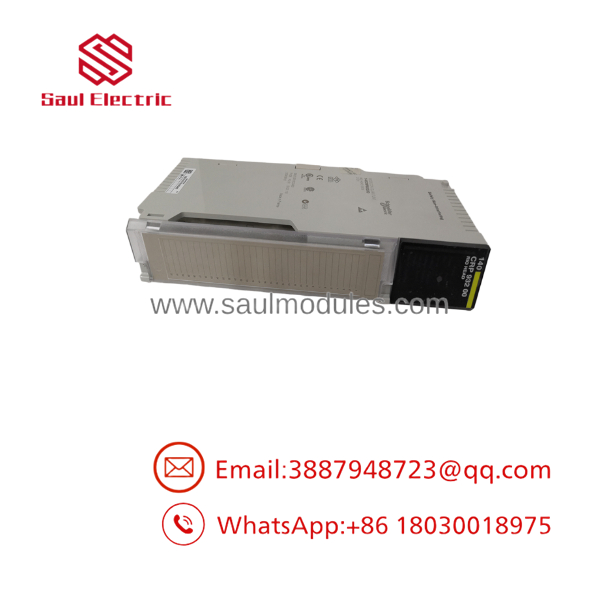
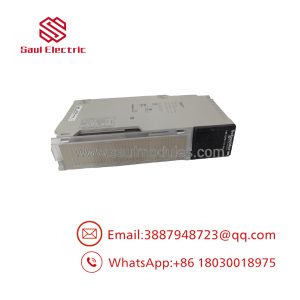
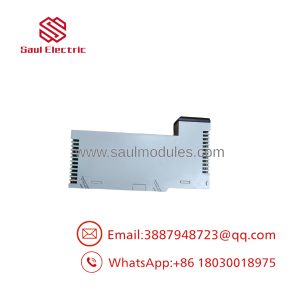
140CRP93200
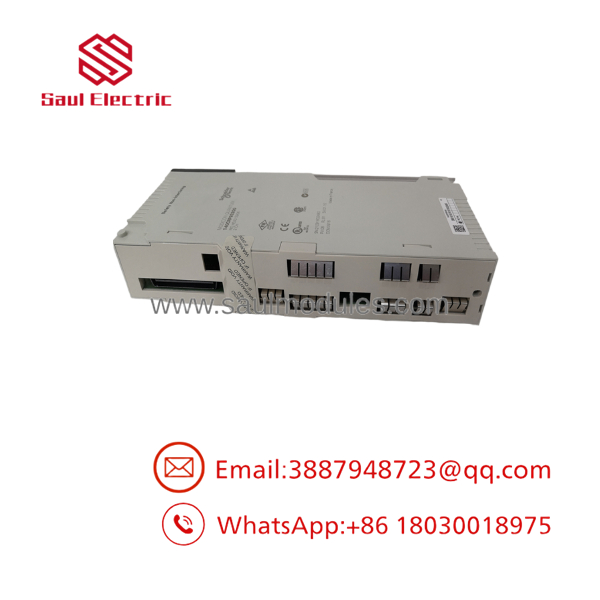
140CRP93200
Transparency SOP: QA & Testing
For New Surplus or refurbished 140CRP93200 inventory, the QA procedure should focus on both the module and its two-channel RIO function.
- Catalog verification — Confirm
140CRP93200on the actual module label. - Physical inspection — Examine the housing, backplane connector, front indicators, and F-type coaxial interfaces.
- Connector inspection — Check both RIO connections for damage, contamination, or mechanical wear.
- Power-up verification — Install the module in a compatible Quantum test rack and check startup diagnostics.
- RIO communication test — Connect the unit to an appropriate test network and verify communication with compatible remote I/O equipment.
- Dual-channel verification — Where the test setup supports it, verify both RIO channels and the applicable redundant-cabling configuration.
- Diagnostic test — Confirm expected status indications during normal operation and controlled network-fault conditions.
- Condition record — Clearly document whether the unit is New Surplus, Used, or Refurbished.
Schneider documentation identifies startup checks including power-up, memory, and LAN-controller checks, which are useful reference points when designing an inspection procedure.
The Veteran’s Tech Trap Guide
⚠️ Trap #1 — Don’t confuse the head module with the remote-drop adapter.
This is the most common identification error.
The 140CRP93200 is the RIO head-end module installed with the controlling CPU. The 140CRA93200 is the remote I/O adapter installed at the remote drop. They perform opposite ends of the communication architecture. Schneider’s hardware guide explicitly separates the RIO head and RIO drop modules.
⚠️ Trap #2 — Don’t substitute the 140CRP93100 without checking redundancy.
Both modules are RIO head modules, but the 93100 has one channel while the 93200 has two. Schneider specifically identifies the 93200’s two-channel configuration and higher 750 mA bus-current requirement.
PRO TIP: Photograph both coaxial connections before removing the old module. Label which cable belongs to each channel. On a live network, that small step can prevent unnecessary troubleshooting.
⚠️ Trap #3 — Do not mistake for Ethernet RIO.
The 140CRP93200 uses the legacy coaxial RIO architecture at 1.544 Mbit/s. It is not an Ethernet remote I/O head. Replacing it with an Ethernet RIO product changes the network architecture and requires an engineering assessment.
⚠️ Trap #4 — Check the entire coaxial path before condemning the module.
troubleshooting should include the cable, taps, connectors, termination, remote drops, and network topology. Schneider maintains a dedicated cable system-planning and installation guide covering network design, installation, testing, and maintenance.
Dynamic FAQ
Q: What is the Schneider 140CRP93200?
A: It is a Modicon Quantum RIO head-end adapter module installed on the controller-side rack. It transfers data between the CPU and remote I/O drops.
Q: How many RIO channels does the 140CRP93200 have?
A: It has two RIO channels with connections designed for redundant coaxial cabling. Schneider confirms that the 140CRP93100 has one channel while the 140CRP93200 has two.
Q: What cable does the 140CRP93200 use?
A: It uses 75 Ω coaxial cable for the remote I/O network. The published transmission rate is 1.544 Mbit/s.
Q: What is the difference between 140CRP93200 and 140CRA93200?
A: The 140CRP93200 is the RIO head-end module on the CPU-side rack, while the 140CRA93200 is the RIO adapter at the remote I/O drop. They are not interchangeable positions in the architecture.
Q: Is the 140CRP93200 discontinued?
A: Yes. Schneider’s U.S. product page lists it as discontinued on March 15, 2022, with end of service scheduled for December 31, 2029. Schneider’s UK listing states that the product has no direct replacement.
Q: How should New Surplus 140CRP93200 inventory be verified?
A: Confirm the exact catalog number on the physical label, inspect both F-type RIO connectors and the backplane connector, and ask whether the unit has been powered and tested on a compatible network. For procurement, obtain a written statement of New Surplus condition, test status, warranty coverage, and return terms.

 Start Chat


