





Description
Product Introduction
The Square D CLE-202001 is an AC current transducer from the Class 8410 instrumentation family. It converts a sinusoidal AC current input into a proportional DC current output that can be used by analog meters, recorders, data loggers, and compatible monitoring systems.
This legacy component is relevant to switchgear, motor-control, and energy-monitoring installations that use low-level analog current signals. When sourcing a replacement, verify the input and output ranges, wiring arrangement, and receiving instrument’s input requirements. Do not substitute a generic DC power supply or a transducer with a different output range.
Key Technical Specifications
| Parameter | Specification |
|---|---|
| Manufacturer | Square D, now part of Schneider Electric |
| Model | CLE-202001 |
| Full catalog reference | 8410-CLE-202001 |
| Product family | Class 8410 |
| Product type | AC current transducer |
| Input signal | 0–5 A AC |
| Output signal | 0–1 mA DC |
| Input type | Sinusoidal AC current |
| Accuracy | Class 8410 literature states 0.25% of rated output; confirm exact unit documentation |
| Input range beyond rated value | Technical literature describes accuracy over 0–6.5 A input |
| Output compliance | Verify the permitted load and compliance voltage in the original manual |
| Mounting | Confirm the original mounting base and physical arrangement |
| Operating temperature | Verify against the applicable original datasheet |
| Lifecycle | Legacy product; manufacturer availability should be confirmed |
The Class 8410 technical literature is the stronger reference for operating characteristics. Third-party listings do not consistently agree on details such as accuracy and mounting, so those values should not be treated as verified for every unit.
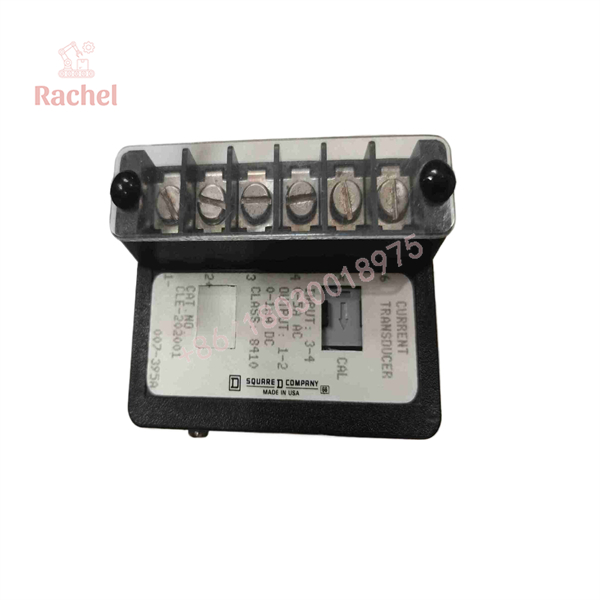
CLE-202001
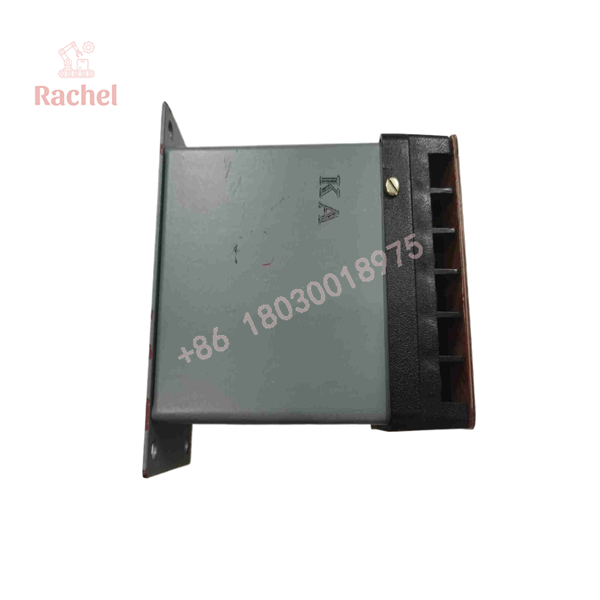
CLE-202001
Application Scenarios & Field Experience
Typical applications
- Switchgear monitoring: Converts current-transformer signals for use by compatible monitoring instruments.
- Motor control centers: Supplies a proportional analog signal for monitoring motor current.
- Generator and power panels: Supports current indication and electrical load monitoring.
- Energy management systems: Feeds a compatible recorder, data logger, or analog acquisition input.
- Legacy instrumentation replacement: Helps maintain existing analog measurement loops without redesigning the entire panel.
These uses align with the Class 8410 literature, which describes current measurement, energy management, and motor and power control applications.
Field troubleshooting example
Illustrative scenario, not a verified customer case.
A switchgear monitoring system reports lower current than expected after maintenance. Before replacing the transducer, the technician should verify the current-transformer ratio, secondary wiring, actual AC input current, output-loop connections, and receiving instrument configuration.
A mismatch between a 0–1 mA DC output and an instrument configured for a different input range can produce incorrect readings even when the transducer itself is functioning correctly.
Transparency SOP: Quality Assurance & Testing
The following is a recommended inspection process for a surplus or refurbished CLE-202001. It does not indicate that a specific unit has already passed testing.
- Part identification: Confirm the label reads
CLE-202001or8410-CLE-202001, and photograph the label and terminal markings. - Physical inspection: Check the housing, terminals, mounting base, and wiring points for cracks, corrosion, loose hardware, or heat damage.
- Input verification: Use an appropriately rated AC current source and follow the original wiring diagram. Never connect an unverified current source directly to the equipment.
- Output calibration: Apply controlled input points across the rated range and measure the DC output using a suitable calibrated instrument.
- Linearity check: Compare the measured output with the expected proportional response and the documented tolerance.
- Load verification: Confirm the receiving instrument’s input resistance and the transducer’s output compliance limits.
- Final QC record: Document the serial or identification label, test conditions, measured values, observed defects, and warranty terms.
Electrical safety: If the transducer is connected to a current-transformer secondary, follow the applicable CT safety procedure. Never leave an energized CT secondary open-circuited.
Veteran’s Tech Trap Guide
- ⚠️ Do not mistake the output for a voltage signal. This model is documented as a 0–1 mA DC output device, not a 0–10 V transmitter or a DC power supply.
- ⚠️ Check the full-scale scaling. A receiving instrument configured for 4–20 mA will not correctly interpret a 0–1 mA output without a suitable interface or redesign.
- ⚠️ Verify the CT ratio and input range. An incorrect CT ratio can create a measurement error even if the transducer is operating normally.
- ⚠️ Do not rely on the short model number alone. Confirm whether the existing equipment is marked
or8410-and match the original terminal arrangement. - ⚠️ Treat surplus condition claims separately from test evidence. Ask for actual calibration results rather than assuming that “tested” or “refurbished” guarantees accuracy.
Frequently Asked Questions
Q1: What does the Square D CLE-202001 do?
It converts an AC current signal into a proportional DC current signal for electrical monitoring and measurement applications.
Q2: What are its input and output ranges?
The documented rating is 0–5 A AC input and 0–1 mA DC output. The Class 8410 literature also describes accuracy across an input range extending to 6.5 A; confirm the conditions and limits in the original manual.
Q3: Can it connect directly to a PLC analog input?
Only if the PLC input supports the transducer’s 0–1 mA DC signal and the electrical loading is compatible. Many PLC analog inputs are designed for voltage or 4–20 mA current loops, so check the input specification first.
Q4: Is the CLE-202001 still manufactured?
A major industrial parts listing marks the full catalog reference 8410- as discontinued by the manufacturer. Availability is therefore likely to depend on surplus inventory, repair services, or specialist sourcing.
Q5: Can I use a different current transducer as a replacement?
Potentially, but the replacement must match the required input range, output signal, accuracy, response characteristics, isolation requirements, mounting, and receiving instrument. A 4–20 mA replacement is not automatically compatible.
Q6: Is a used or surplus unit suitable for critical monitoring?
It may be suitable after its identity, condition, calibration, and application compatibility have been verified. For critical measurements, require documented test results and an approved commissioning procedure.
Q7: What information should I provide when requesting a quote?
Provide the complete model reference, required quantity, preferred condition, a photo of the existing label, the receiving instrument’s input specification, and your delivery destination.

 Start Chat


