





Description
Product Introduction
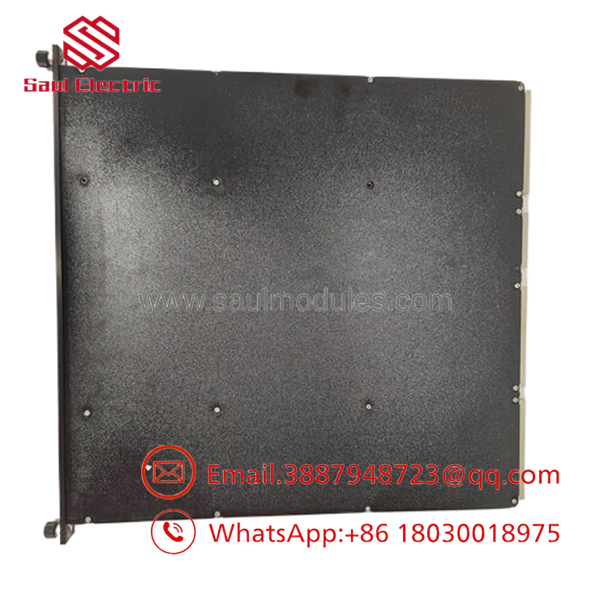
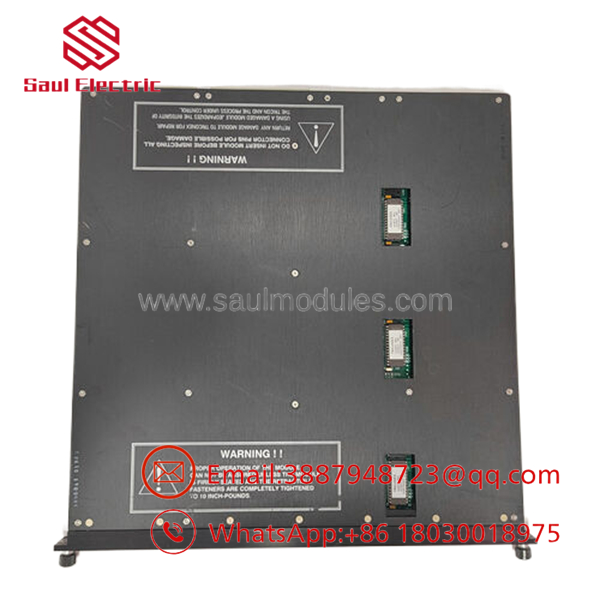
The Triconex 3700A is a 32-channel Triple Modular Redundant (TMR) Analog Input Module used in Tricon Safety Instrumented Systems to acquire low-voltage analog process signals. Each field input is sampled independently by three isolated processing channels before the Tricon Main Processors perform mid-value selection, allowing the controller to tolerate a single channel fault without losing the measurement.
Unlike a standard PLC analog input card, the 3700A continuously performs onboard diagnostics while remaining online and supports hot-spare replacement. One thing to watch out for is the common-mode voltage limit. If it is exceeded, measurement accuracy on other channels can no longer be guaranteed. Verify sensor wiring, shielding, and grounding before replacing the module.
Key Technical Specifications
| Parameter | Value |
|---|---|
| Manufacturer | Triconex (Schneider Electric) |
| Model | 3700A |
| Product Type | TMR Analog Input Module |
| System | Tricon Safety Instrumented System |
| Input Channels | 32 Differential, DC-Coupled |
| Input Voltage Range | 0–5 VDC |
| Over-Range Measurement | Up to 5.3 VDC (+6%) |
| Resolution | 12-bit |
| Accuracy | <0.15% Full Scale (0–60°C) |
| Input Update Rate | 55 ms |
| Input Resistance | 30 MΩ Minimum |
| Common-Mode Range | -12 V to +12 V Peak |
| Over-Voltage Protection | 150 VDC Continuous / 115 VAC Continuous |
| Input Current Support | 0–20 mA with External 250 Ω Shunt Resistor |
| Logic Power | <10 W |
| Status Indicators | PASS, FAULT, ACTIVE |
| Hot-Spare Capability | Supported |
Engineering Note: The 3700A accepts voltage inputs only. When connecting 4–20 mA transmitters, an approved 250 Ω precision shunt resistor is required to convert the current signal into a 1–5 V input.
Application Scenarios & The “Trench” Experience
Analog input problems rarely begin inside the controller.
A refinery reported unstable reactor pressure readings every afternoon. Operators suspected the safety controller because several channels drifted simultaneously. The maintenance team prepared a replacement 3700A.
It wasn’t the module.
The shield drain wire had been grounded at both ends after a cable modification, creating a ground loop that introduced common-mode noise. Once the wiring was corrected, every channel returned to normal.
That’s why experienced SIS engineers always investigate the signal path before changing electronics.
Typical Applications
Oil & Gas — Emergency Shutdown Systems — Monitors pressure, temperature, and flow transmitters used for shutdown logic.
Power Generation — Turbine Protection — Acquires lube oil pressure, bearing temperature, and hydraulic control signals.
Chemical Processing — Reactor Protection — Measures reactor pressure, vessel level, and cooling water flow.
Refineries — Burner Management Systems — Monitors combustion air pressure and fuel control instrumentation.
Pipeline Facilities — Compressor Protection — Collects analog measurements from vibration monitors and process transmitters.
Field Replacement Example
During scheduled proof testing at an LNG facility, several analog channels reported intermittent diagnostic alarms. Engineers first verified transmitter calibration and measured common-mode voltage. After eliminating field wiring issues, they installed a tested 3700A and repeated the loop tests. The replacement restored stable operation, while bench testing later confirmed an intermittent internal analog front-end fault in the original module. Plant startup remained on schedule because a verified spare was available.
- 3700A
- 3700A
Transparency SOP: Quality Assurance & Testing
We don’t just ship boxes; we test them on actual Tricon racks whenever compatible hardware is available.
1. Inbound Inspection
- Verify Schneider Electric identification labels
- Inspect PCB assemblies and analog input circuitry
- Examine connectors for oxidation or wear
- Record hardware revision and serial number
2. Live Rig Testing
- Install into a compatible Tricon chassis
- Verify startup diagnostics
- Inject calibrated voltage signals into multiple channels
- Confirm communication with Main Processors
- Verify PASS, FAULT, and ACTIVE indicators
3. Electrical Parameter Checks
- Analog accuracy verification
- Resolution validation
- Input impedance measurement
- Over-range response verification
4. Hardware Verification
- Record hardware revision
- Confirm module identification
- Verify compatibility with supported Tricon firmware
5. Final QC & Anti-static Packaging
- Complete functional inspection
- Anti-static moisture-barrier packaging
- Industrial protective cushioning
- Serialized inventory tracking
- 12-month warranty documentation
The Veteran’s Tech Trap Guide
⚠️ Watch the Common-Mode Voltage
The 3700A is rated for a common-mode range of -12 V to +12 V peak. Exceeding that limit can affect measurement accuracy on multiple channels, even if only one transmitter is wired incorrectly.
⚠️ Don’t Forget the Shunt Resistor
Connecting a 4–20 mA transmitter directly to the module won’t work correctly. Install the specified 250 Ω precision resistor to convert the current loop into a 1–5 VDC input.
❗Ground Shields at One End Only
Double-ended shield grounding is a common cause of unstable analog readings. Before replacing the module, inspect the cable shields and field grounding practices.
⚠️ Rapidly Changing Signals Can Trigger Mis-Compare Diagnostics
The three TMR channels compare measured values continuously. Extremely fast-changing analog signals can occasionally generate temporary mis-compare indications even when the module is healthy. Review the event history before assuming hardware failure.
Frequently Asked Questions (FAQ)
Q1. What signals does the Triconex 3700A accept?
The 3700A accepts 32 differential 0–5 VDC analog input signals. Current-loop transmitters can also be used when an external 250 Ω shunt resistor converts the signal to the required voltage range.
Q2. Does the module support hot replacement?
Yes. The 3700A supports hot-spare capability, allowing online replacement according to Schneider Electric maintenance procedures. During replacement, the controller continues operating with reduced redundancy until the spare module synchronizes.
Q3. Why are the inputs differential?
Differential inputs improve noise rejection and measurement stability in electrically noisy industrial environments, especially where long instrument cables are installed.
Q4. Can I connect a 4–20 mA transmitter directly?
No. The module measures voltage. Use a 250 Ω precision shunt resistor to convert the current loop into a compatible 1–5 VDC signal.
Q5. Why is this module less expensive than buying directly from Schneider Electric?
Most available inventory originates from strategic spare inventories, canceled expansion projects, or plant modernization programs. Pricing reflects the procurement source rather than operating capability.
Q6. Is every module tested before shipment?
Yes. Every module undergoes visual inspection, power-up verification, calibrated analog signal testing, communication verification, diagnostic validation, connector inspection, and final quality control before anti-static packaging.
Q7. What should I verify before ordering?
Confirm the following:
- Part number (3700A)
- Tricon controller generation
- Hardware revision
- Supported firmware version
- Input signal type (0–5 VDC or 4–20 mA with shunt)
- External termination panel (ETP) compatibility
- Field wiring and grounding configuration
Veteran’s advice: If several analog channels drift together, don’t assume the module has failed. Check transmitter power supplies, verify shield grounding, measure common-mode voltage, and review the diagnostic log. In many shutdown investigations, the 3700A is accurately reporting a field wiring problem—not causing it.

 Start Chat


