





Description
Product Introduction
The Watlow Anafaze CLS216 consolidates 16 independent control loops into one controller for machinery with multiple temperature zones. It is used in industrial heating and thermal-processing systems where separate setpoints, process feedback, alarm handling, and control outputs are required across several zones.
The controller supports thermocouple and configurable linear analog inputs, with serial communications for integration into supervisory systems. Because the CLS216 is a legacy platform, replacement planning should account for the installed firmware, terminal board, signal wiring, and control-output assignment—not just the front-panel model number.
Key Technical Specifications
| Parameter | Specification |
|---|---|
| Manufacturer | Watlow Anafaze |
| Model | CLS216 |
| Product family | CLS200 |
| Control capacity | 16 control loops |
| Analog inputs | 16 single-ended inputs |
| Additional input | One pulse input |
| Thermocouple inputs | Supported; sensor type is configurable |
| Linear voltage inputs | −10 to +60 mV direct input; additional ranges available with scaling resistors |
| Current inputs | 0–20 mA or 0–10 mA with appropriate scaling resistors |
| Internal measurement resolution | Greater than 14 bits; approximately 0.006% |
| Input sampling rate | 1.5 samples/second at 60 Hz; 1.25 samples/second at 50 Hz |
| Serial interface | EIA/TIA-232 or EIA/TIA-485 |
| Communication protocols | Modbus RTU and legacy Anafaze/AB-compatible protocol options, depending on setup |
| Digital outputs | Up to 34 with the 50-pin terminal-board option |
| Power supply | 15–24 VDC nominal, with documented tolerance; verify the applicable manual and unit label |
| Firmware options | Standard, ramp-and-soak, enhanced features, or custom firmware, depending on order configuration |
| Lifecycle | Legacy controller; confirm stock and support status |
Specifications are drawn from the Watlow CLS200 documentation. The CLS216 uses single-ended inputs and has a slower input sampling rate than the smaller CLS204 and CLS208 models. RTD support and output capabilities must not be assumed from the series name alone.
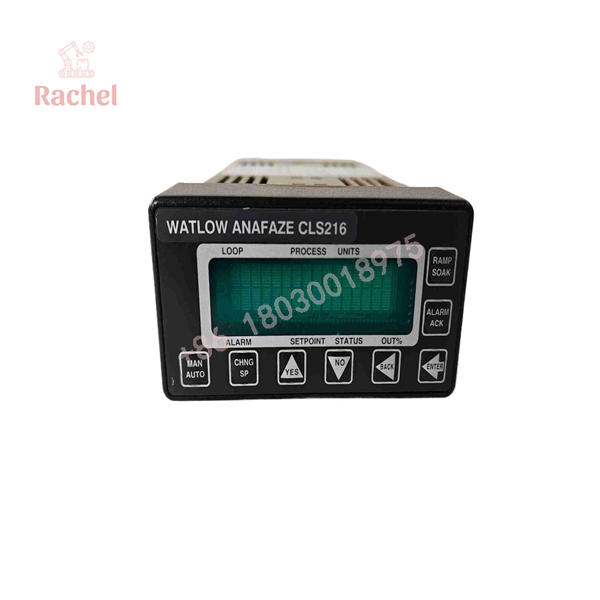
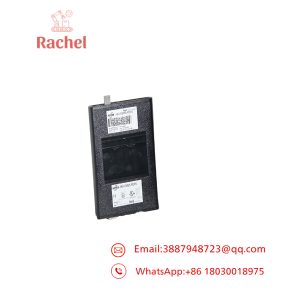
CLS216
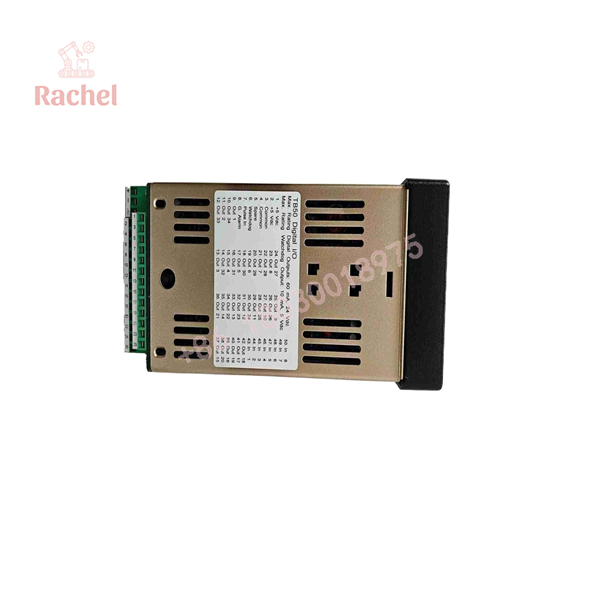
CLS216
Application Scenarios & Field Experience
Typical applications
- Plastic extrusion: Controls multiple barrel, adapter, and die heating zones.
- Industrial ovens: Maintains independent temperature setpoints across heating sections.
- Thermal-processing machinery: Coordinates several process zones requiring individual feedback and alarms.
- Packaging and converting equipment: Regulates multiple heater zones in production machinery.
- Legacy process lines: Maintains existing multi-zone control systems where replacing the complete controller architecture would require substantial re-engineering.
Field troubleshooting example
Illustrative scenario, not a verified customer case.
A production line experiences uneven heating after a CLS216 replacement. The display shows plausible temperatures, but several zones respond differently from the original controller.
The maintenance team should verify thermocouple type and polarity, input scaling, control-output assignment, firmware features, and PID parameters. The terminal-board option also matters: a controller configured for a 50-pin mass-termination board may not match an installation wired for an 18-pin terminal block. Check the wiring and configuration before changing tuning parameters.
Transparency SOP: Quality Assurance & Testing
The following is a recommended inspection procedure for a new-surplus, used, or refurbished CLS216. It is not a statement that a particular unit has already passed these tests.
- Identity verification: Record the full model and ordering code, firmware option, terminal-board type, and communications configuration.
- Physical inspection: Check the display, keypad, connectors, terminal board, and mounting hardware for damage, corrosion, or signs of overheating.
- Power verification: Confirm the unit’s power requirements against the nameplate and applicable manual before energizing it.
- Input-channel test: Use an appropriate calibrated thermocouple simulator or millivolt source to check each required input channel.
- Loop-function test: Verify process-variable readings, setpoint handling, alarms, and control response for each loop used by the application.
- Output test: Check the configured control outputs with a suitable test setup. Verify the terminal board and output wiring before connecting heaters or other loads.
- Communications test: Confirm the serial interface, wiring, baud rate, address, and protocol with the intended host system.
- Final QC record: Document the tested channels, firmware identification, measured results, defects, and warranty terms.
Safety requirement: Before reconnecting the controller to production equipment, verify output action, alarm behavior, and the process’s independent safety limits. A controller’s successful power-up does not prove that its control outputs are correctly configured.
Veteran’s Tech Trap Guide
- ⚠️ Do not confuse input count with control-loop count. The CLS216 is a 16-loop controller with 16 analog inputs and an additional pulse input.
- ⚠️ Check input type and scaling. The CLS216 uses single-ended inputs. Do not assume its wiring or signal compatibility is identical to the CLS204 or CLS208.
- ⚠️ Verify the terminal-board option. The 50-pin option supports more digital I/O than the 18-pin configuration. Confirm the installed board and cable before purchasing.
- ⚠️ Confirm the firmware features. Ramp-and-soak and enhanced control functions depend on the installed firmware option. A basic replacement may not reproduce the original process sequence.
- ⚠️ Don’t assume modern communication compatibility. The documented serial interfaces and protocols are configuration-dependent. Check the PLC or SCADA driver and actual communication settings before installation.
Frequently Asked Questions
Q1: What does the Watlow Anafaze CLS216 do?
It controls up to 16 independent temperature or process loops from a single CLS200-series controller.
Q2: What sensor inputs does the CLS216 support?
The CLS200 documentation describes thermocouple inputs and configurable linear voltage/current inputs. RTD support is listed for CLS204 and CLS208, so do not assume RTD compatibility on the CLS216 without model-specific documentation.
Q3: Can the CLS216 communicate with a PLC?
Yes, it supports serial communications through EIA/TIA-232 or EIA/TIA-485, with supported protocols depending on the configuration. Verify protocol, baud rate, wiring, and the PLC driver before integration.
Q4: Does it support ramp-and-soak control?
Ramp-and-soak is an available CLS200 firmware option. Confirm that the existing controller has this option and that the replacement has the required firmware.
Q5: Can I replace a CLS216 with a newer Watlow controller?
A newer controller may be suitable, but replacement is not necessarily plug-and-play. Review input types, output hardware, terminal wiring, communications, firmware functions, and control-program requirements before choosing a substitute.
Q6: Is the CLS216 still manufactured?
It is a legacy product family. Watlow maintains CLS200 documentation, including a guide for legacy models, but current production and stock availability should be confirmed directly with Watlow or the supplier.
Q7: What should I provide when requesting a quote?
Provide the full model and suffix, quantity, terminal-board type, firmware option, power arrangement, serial interface, preferred condition, and delivery destination. A photo of the nameplate and existing wiring connectors can help prevent an incompatible replacement.

 Start Chat


