





Description
Product Introduction & Engineering Value
Few things expose weak control loops like trying to parallel a fast-starting emergency generator onto a stiff, fluctuating factory bus. The Woodward 8440-2165 is engineered exclusively to conquer that challenge, serving as a dedicated, high-speed microprocessor synchronizer that takes the guesswork out of breaker closure timing.
For years, senior field engineers have relied on the SPM-D2-11 because it isolates the critical math of sync-checking from the general machine automation layers. It treats phase alignment as a precision real-time tracking problem, using hardware-driven predictive algorithms to command breaker closure at the exact millisecond the slip frequency and phase angle cross zero.
Technical Specifications
Because this unit operates directly on true RMS phase parameters and analog correction trims, its core technical boundaries are best mapped out within a structured format:
| Measurement & Control Point | Factory Target Rating / Constraint |
| Nominal Sense Input (Generator) | 100 VAC or 400 VAC options (software switchable ranges) |
| Nominal Sense Input (Busbar) | Single-phase or three-phase true RMS matching up to 440 VAC |
| Operating DC Control Voltage | 24 VDC nominal supply boundary (18 to 30 VDC clean rail) |
| Frequency Matching Window | 50/60 Hz nominal base parameters (tracking from 40 to 70 Hz) |
| Speed Bias Analog Signal | Isolated discrete pulse outputs or linear ±10 VDC voltage trim |
| Voltage Bias Analog Signal | Configurable output signals compatible with standard industrial AVRs |
| Housing Dimensions & Cutout | Compact panel-flush mount enclosure (144mm by 72mm front face) |
| Safety Certification Class | CE marked, UL listed component classification |
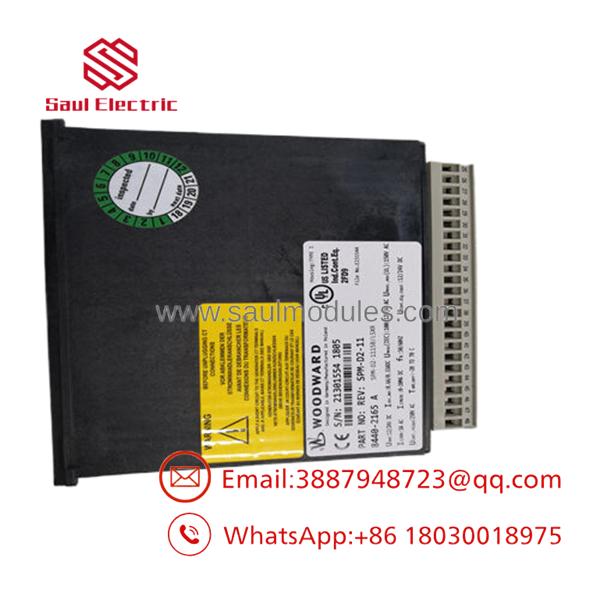
- 8440-2165 SPM-D2
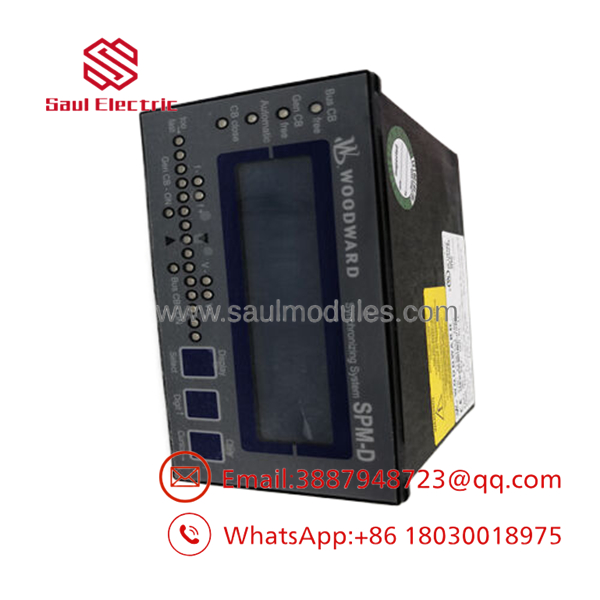
- 8440-2165 SPM-D2
Field Application & The “Trench” Experience
During a marine propulsion upgrade on a mid-sized cargo vessel, the secondary auxiliary engine kept dropping offline due to overcurrent whenever the crew activated the main bow thruster. The old analog synchronizer took over forty seconds to match frequencies, allowing the bus voltage to sag under the transient load before the second generator could close its breaker. We swapped the faulty unit out for a fresh 8440-2165. The SPM-D2-11 cut the synchronization window down to less than four seconds, snapping the auxiliary generator into perfect phase alignment before the heavy motor starter sequence could pull the ship’s primary bus into a blackout state.
- Marine Main Switchboard Synchronization: Interlocking emergency auxiliary diesels with the primary distribution bus under high sea states.
- Islanded Microgrid Peak Shaving: Dynamically matching local factory gas turbine loops to incoming utility lines during mid-day load spikes.
- Isolated Hydro-Electric Balancing Loops: Modulating slow-response water turbine gates using precise pulse-width speed bias inputs.
Transparency SOP: QA & Testing
Our systematic quality assurance loop protects your field reliability through a strict testing workflow:
- Visual Inspection: We audit the terminal blocks, structural mounting clips, and display glass for structural anomalies.
- Waveform Synthesis: High-accuracy signal generators inject artificial phase variations between the simulated generator and bus inputs.
- Timing Calibration: We verify that the phase-angle window calculation triggers the breaker-close relay within 5% of the programmed predictive lead time.
- Burn-in Profiling: The controller runs continuously under full logic load for 24 hours to eliminate infant mortality field failures.
The Veteran’s Tech Trap Guide
⚠️ THE BREAKER DELAY TRAP: Do not guess your circuit breaker’s mechanical closing time. The 8440-2165 uses a predictive function that triggers the “Close” relay early to account for the physical inertia of the breaker contacts. If you leave this parameter at the factory default but your breaker takes 120 milliseconds to close, you will close out of phase, producing an audible mechanical slam that stresses the generator rotor shafts.
PRO TIP: When dealing with older analog woodward governors (like the 2301A series), ensure your speed bias connection configuration on the SPM-D2 matches the input scaling exactly. Wiring a differential voltage output into an engine control node configured for simple dry-contact pulse inputs will lock the governor at minimum idle speed.
Dynamic FAQ
- Q: What is the main operational difference between this SPM-D2-11 and basic sync-check relays?
- A: A basic sync-check relay is entirely passive; it only waits for phase alignment to happen naturally. The 8440-2165 SPM-D2-11 actively corrects the engine’s speed and voltage, forcing the generator into alignment quickly via analog output bias trims.
- Q: Can this unit monitor three-phase networks or is it limited to single-phase sensing?
- A: The SPM-D2-11 model supports true RMS evaluation across multiple phases, giving you much better protection against single-phase dropouts on the main busbar.
- Q: How does the front display handle diagnostic troubleshooting?
- A: The bright red LED screen displays real-time values for both the bus and generator voltages and frequencies simultaneously, accompanied by an explicit LED sync-scope display indicating whether the engine is running too fast or too slow.
- Q: Do your New Surplus 8440-2165 units include the hardware mounting brackets?
- A: Yes. All units ship complete with their original panel-mounting hardware clamps, protective rear terminal covers, and our certified 12-month performance warranty.



 Start Chat


