





Description
Product Introduction & Engineering Value
The Woodward 9905-972 is a legacy LINKnet analog-output node used when a Woodward control system needs multiple 4–20 mA command signals at a distributed I/O location. Its six channels can interface with current-loop field devices such as positioners, indicators, or other control-system interfaces.
This is an important distinction when sourcing a replacement: 9905-972 is an analog output module, not a 4–20 mA input card. Woodward’s own documentation identifies separate LINKnet part numbers for 4–20 mA input and output functions.
Technical Specifications
| Specification | 9905-972 Details |
|---|---|
| Manufacturer | Woodward |
| Part Number | 9905-972 |
| I/O Family | LINKnet |
| I/O Type | Analog Output |
| Number of Channels | 6 |
| Output Range | 4–20 mA |
| Resolution | 12-bit |
| Output Monitoring | Yes; output current is monitored through an A/D converter |
| Power Requirement | 6.0 W at 24 V input, according to Woodward manual data |
| Network Address | 18 in the documented 723PLUS LINKnet configuration |
| Communication | LINKnet distributed I/O network |
| Output Protection / Supervision | Watchdog-controlled output drivers |
| Module Status | Legacy / obsolete |
Woodward specifies the 4–20 mA output module as six channels with 12-bit resolution, a 250 ppm/°C temperature coefficient, and approximately 6.0 W power consumption at 24 V in the documented LINKnet I/O specification.
Output monitoring matters
The 9905-972 is not simply a six-channel D/A converter. Woodward describes a D/A stage feeding the current drivers, with the actual output current monitored through an A/D converter. The readback value and status are available to the application program.
That makes the module useful for troubleshooting because an apparent command-output problem can be separated into a control/network problem and an actual analog-output problem.
LINKnet Architecture and Channel Assignment
In Woodward’s 723PLUS Performance Control documentation, the 9905-972 occupies LINKnet address 18:
- Network address: 18
- Six analog-output channels
- 4–20 mA output
- One 9905-972 node in the documented configuration
- Six total analog output channels
The same architecture supports other LINKnet nodes, including 4–20 mA inputs, RTD inputs, thermocouple inputs, discrete inputs, and relay outputs.
This is why substituting a superficially similar Woodward I/O module can cause a configuration fault. The controller expects the module type associated with the configured node address.
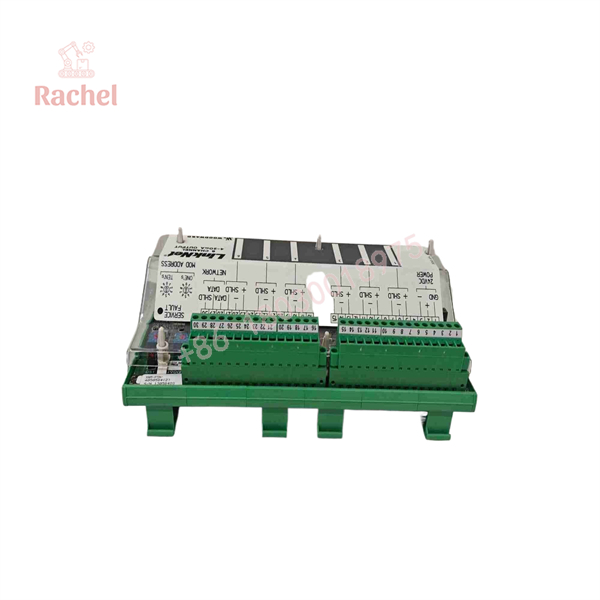
9905-972
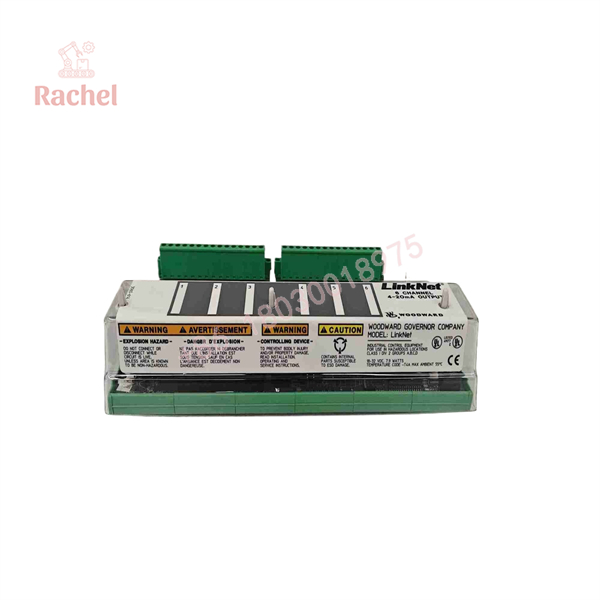
9905-972
Field Application & Practical Engineering Scenario
Example: Turbine control cabinet with a failed analog command channel
Consider a legacy turbine control cabinet where one analog command sent to a field positioner has dropped to zero. The engineer sees the controller generating the expected command internally, but the field device no longer responds.
A useful troubleshooting sequence is:
- Check the LINKnet communication status.
- Verify that the installed node is configured for the correct module type.
- Confirm that the node address matches the application configuration.
- Check the relevant 4–20 mA channel wiring.
- Measure the physical current at the field terminals.
- Compare the physical output with the module’s reported readback value.
- If the output node has lost communication, inspect the network wiring and termination before condemning the module.
Woodward specifically states that an incorrect module address can generate a “no message” fault, while installing the wrong module type can produce a type fault.
Other suitable application scenarios
Turbine auxiliary control
- Valve or positioner command
- Remote analog reference
- Local indication
Engine control systems
- Analog command signals
- Auxiliary control loops
- External instrumentation interfaces
Generator and power-generation systems
- Distributed analog command paths
- Control-system interface signals
- Retrofit/maintenance of legacy Woodward LINKnet installations
These applications should be treated as system-dependent examples, not proof that every 9905-972 can be substituted directly into every Woodward turbine or engine control system.
QA & Testing SOP for New Surplus / Refurbished Stock
Because 9905-972 is a legacy module, purchasing condition and electrical verification matter as much as the part number.
Recommended inspection sequence
1 — Identity check
- Verify the Woodward nameplate.
- Confirm 9905-972.
- Record revision/serial information where present.
- Compare the physical module with the customer’s existing unit.
2 — Physical inspection
- Inspect terminal blocks and connectors.
- Check the PCB and housing for contamination or corrosion.
- Look for damaged components, cracked solder joints, or evidence of overheating.
3 — Power-up test
- Apply the correct test supply using the applicable Woodward documentation.
- Check module status indications.
- Confirm that the processor initializes normally.
4 — Network test
- Connect the module to a compatible LINKnet test environment.
- Verify the expected node address.
- Check for communication and type/address faults.
5 — Analog-output test
- Exercise all six output channels.
- Test representative points across the 4–20 mA range.
- Verify output-current readback where supported.
- Confirm that each channel responds independently.
6 — Documentation
For a surplus or refurbished unit, record:
- Actual part number
- Revision
- Serial number
- Test date
- Channel test results
- Physical condition
- Warranty terms
Woodward documentation also describes hot replacement of faulty LINKnet nodes in the applicable system architecture, with the replacement node set to the same address as the removed unit.
Veteran’s Tech Trap Guide
⚠️ Trap 1: Confusing 9905-972 with 9905-969
These numbers are close, but the functions are different.
- 9905-969 = 6-channel 4–20 mA input with 24 V loop power
- 9905-972 = 6-channel 4–20 mA output
Woodward explicitly lists them as separate LINKnet modules.
PRO TIP: Match the I/O direction before comparing physical appearance or connector layout.
⚠️ Trap 2: Ignoring the LINKnet node address
For the documented 723PLUS configuration, 9905-972 uses address 18. An address mismatch can prevent communication, while the wrong module type at an expected address can produce a type fault.
PRO TIP: Photograph or record the existing rotary-switch settings before removing the failed node.
⚠️ Trap 3: Treating it as a current-generation LINKnet replacement
Woodward announced the obsolescence of the LON-based LINKnet nodes, including 9905-972. Regular production of the LON-based LINKnet architecture had ended earlier, while existing modules remained available as spare parts for installed systems. Woodward subsequently identified LINKnet HT modules as the updated architecture.
PRO TIP: For an existing machine, exact replacement may be appropriate. For a new control-system design, do not assume 9905-972 is the correct architecture.
Dynamic FAQ
What is Woodward 9905-972?
It is a LINKnet six-channel 4–20 mA analog output module used in legacy Woodward distributed I/O architectures.
Is 9905-972 an analog input module?
No. 9905-972 is an analog output module. Woodward separately identifies 9905-968 and 9905-969 as 4–20 mA input modules.
How many analog outputs does it provide?
The module provides six 4–20 mA output channels with 12-bit resolution in the documented LINKnet specification.
Is 9905-972 obsolete?
Yes. Woodward’s product-change documentation identifies the LON-based LINKnet modules, including 9905-972, as obsolete/non-preferred for new systems and states that they remained available as spare parts for existing installations.
Can a newer LINKnet HT module simply replace 9905-972?
Not necessarily. Woodward states that the updated system uses a different network architecture and requires hardware and software changes. Replacement therefore needs to be checked against the complete control-system configuration rather than treated as a plug-and-play substitution.
What does “New Surplus” mean for 9905-972?
New Surplus generally means the unit is unused or has not been installed in service, but it is not automatically equivalent to current factory production. For a legacy part such as 9905-972, the supplier should provide clear condition information, actual nameplate/serial evidence, and functional test results.
Warranty: Warranty coverage should be stated separately by the seller and should specify the covered period and whether the unit is new surplus, unused, repaired, or refurbished.

 Start Chat


