





Description
Product Introduction
The ABB CI801 (3BSE022386R1) is a PROFIBUS DP-V1 Fieldbus Communication Interface (FCI) head module engineered for ABB S800 I/O architectures. Mounted on a dedicated TU810, TU812, or TU830 terminal base unit, it acts as the central communication bridge connecting remote S800 I/O expansion clusters to an AC 800M controller or third-party PROFIBUS DP master.
Automation engineers choose the CI801 because it executes local optical I/O bus management autonomously while streaming process variables over high-speed PROFIBUS up to 12 Mbps. Supporting up to 12 direct S800 I/O modules on the main cluster (and up to 24 total with ModuleBus extension cables), it combines high channel density with online re-configuration and diagnostic pass-through capabilities.
Key Technical Specifications
| Parameter | Specification |
| Full Part Number | CI801 (3BSE022386R1) |
| Fieldbus Protocol | PROFIBUS DP-V1 (RS-485 physical layer) |
| Baud Rate | Up to 12 Mbps (auto-detect) |
| Nominal Supply Voltage | 24 V DC (19.2 to 30 V DC range) |
| Power Consumption | Max 160 mA at 24 V DC |
| Local ModuleBus Capacity | Up to 12 modules on main cluster (max 24 with extension) |
| Compatible Terminal Bases | TU810V1, TU812V1, TU830V1, TU838 |
| Addressing Method | 2x rotary hex switches (01 to 99) for station address |
| Operating Temperature | 0°C to +55°C (32°F to 131°F) |
| Power Dissipation | Approx. 3.8 W internal |
Application Scenarios & The “Trench” Experience
A pharmaceutical plant in New Jersey experienced an emergency shutdown when a power surge fried the communication board on a remote S800 I/O drop inside a sterile suite. The host AC 800M controller instantly logged a PROFIBUS node failure, halting a $140,000 batch process. The maintenance engineer swapped the damaged module onto the existing TU810 base unit, set the two front panel rotary switches to node address ’14’ to match the old card, and re-applied power. The CI801 established a PROFIBUS handshake in under 30 seconds, restoring I/O mapping without requiring a CPU cold boot.
- Chemical Batching Facilities – Remote Valve & Sensor Clusters – Translates digital and analog field signals from explosion-proof S800 drops directly to a central DCS.
- Oil & Gas Pipeline Stations – Distributed Pressure Monitoring – Connects remote pressure and temperature transmitters across long-distance PROFIBUS DP cable loops.
- Water & Wastewater – Pump Station Remote I/O – Manages motor starters, flow switch contacts, and VFD speed setpoints over redundant PROFIBUS backbones.
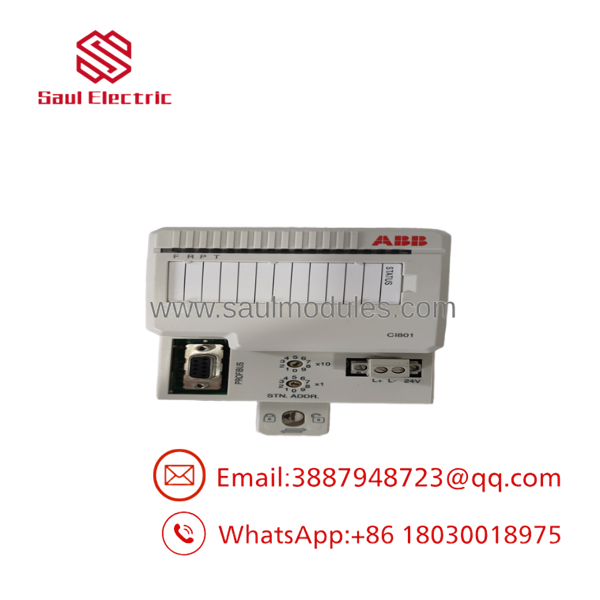
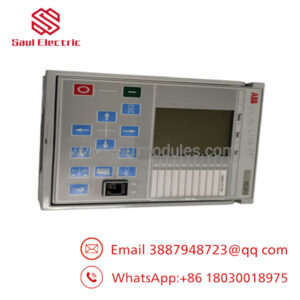
- CI801
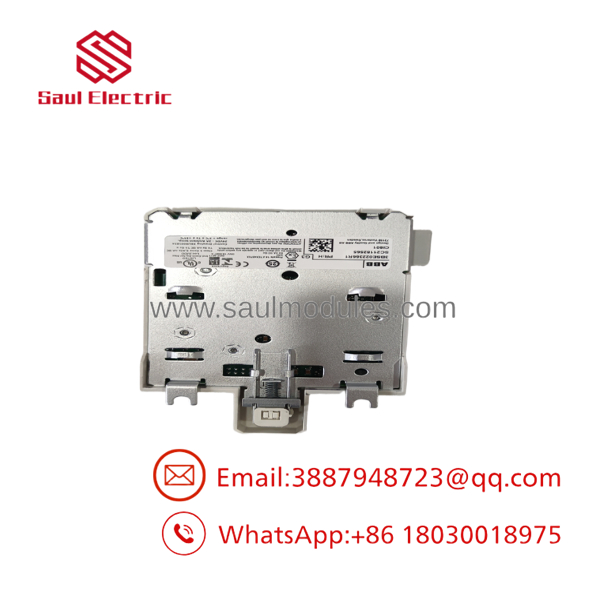
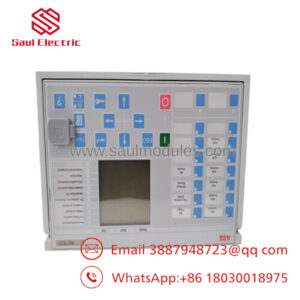
- CI801
Transparency SOP: Quality Assurance & Testing
We test every FCI module on an active S800 testing rack before approving it for warehouse static wrap:
- Inbound Hardware Inspection: We examine backplane pin rows, test terminal release latches, check the casing for cracks, and verify the original ABB serial labels.
- Power Rail & Logic Initialization: Connect 24 V DC to the baseplate terminals to verify internal power conversion, logic startup, and LED indicator self-tests (RUN, FAULT, LINE).
- 12 Mbps PROFIBUS Data Loop: Connect the module to an active PROFIBUS DP master simulator at 12 Mbps. Run full-duplex cyclically to confirm zero frame drops or parity errors.
- ModuleBus Expansion Check: Attach a string of digital and analog I/O cards to the ModuleBus interface to verify channel addressing and local power bus distribution.
- ESD Clearance & Moisture Barrier Seal: Clean signal contacts with residue-free solvent, wrap in anti-static ESD shielding, and enclose with fresh desiccant packs.
The Veteran’s Tech Trap Guide (Crucial Value-Add)
⚠️ The Rotary Station Address Match: Take a photo of the two rotary switches on the front panel of the old card before removing it! PROFIBUS node addresses are read by the only during initial bootup. If you set the rotary switches after applying power, the module will continue operating under its previous address until you cycle 24 V DC power.
❗ Missing ModuleBus Termination (TB807): If your drop uses ModuleBus extension cables (TK801) to split I/O cards across multiple DIN rails, you must install a TB807 ModuleBus terminator on the last open socket. Leaving the local ModuleBus unterminated causes erratic I/O channel faults and random card dropouts.
⚠️ Do Not Force the Module onto the Base: The slides vertically onto its terminal base (such as the TU810). Ensure the locking mechanism is fully disengaged before pressing down. Rocking the card or forcing it at an angle can shear the gold-plated male header pins inside the terminal socket base.
Frequently Asked Questions (FAQ for Conversion)
Q: What is the main difference between the and the CI840?
A: The is a single-channel (non-redundant) PROFIBUS DP-V1 FCI module. The CI840 is a high-availability dual-channel interface designed specifically for redundant PROFIBUS configurations on TU840/TU841 baseplates.
Q: Does the require firmware loading prior to installation?
A: No. The contains factory-loaded operational firmware. When connected to a PROFIBUS network, the host controller pushes down the GSD hardware configuration file parameters automatically during initialization.
Q: Can I hot-swap a module during system operation?
A: You can physically pull the from its base unit under power, but doing so will instantly drop communication to all I/O modules connected to that local ModuleBus cluster. Ensure downstream control loops are placed in manual before swapping.
Q: What power supply requirements does the have?
A: The module operates on standard 24 V DC (19.2 to 30 V DC range). External power is wired directly to the L+ and L- terminals of the mating terminal base unit (e.g., TU810), which powers both the logic and the local ModuleBus.
Q: What warranty coverage do you provide on this module?
A: We back all new surplus and fully reconditioned (3BSE022386R1) modules with a comprehensive 12-month advance replacement warranty. If a module fails or loses network synchronization within 365 days, we ship a replacement immediately.

 Start Chat


