





Description
Key Technical Specifications
| Parameter | Value |
|---|---|
| Manufacturer | ABB |
| Model | DI810 (3BSE008508R1) |
| Product Type | Digital Input Module |
| Series | S800 I/O |
| Number of Inputs | 16 Digital Inputs |
| Signal Voltage | 24 V DC |
| Input Voltage Range | Logic “1”: 15–30 V DC; Logic “0”: -30 to +5 V DC |
| Input Current | 6 mA at 24 V DC |
| Input Configuration | Two isolated groups of 8 channels |
| Input Impedance | 3.5 kΩ |
| Digital Filter | Selectable: 2, 4, 8, or 16 ms |
| Maximum Field Cable Length | 600 m |
| ModuleBus Current | 50 mA @ +5 V |
| Power Dissipation | Typical 1.8 W |
| Protection Rating | IP20 |
| Operating Temperature | 0 to +55 °C |
| Compatible MTUs | TU810V1, TU812V1, TU814V1, TU818, TU830V1, TU833, TU838, TU850 |
Product Introduction & Supply Chain Strategy
The ABB DI810 is a 16-channel 24 V DC digital input module for the S800 distributed I/O platform. It acquires discrete field signals from switches, sensors, pushbuttons, and other digital devices while providing optical isolation, voltage supervision, and diagnostics through the ModuleBus.
This product is a Brand New Surplus unit. It is not used, not pulled from a decommissioned plant, and not refurbished. All modules undergo rigorous quality verification to ensure OEM-level reliability. For production facilities using ABB S800 I/O, maintaining 1–2 on-site spare modules reduces lead time variability and minimizes production risk. New Surplus inventory provides a lower Total Cost of Ownership (TCO) than emergency procurement or refurbished hardware while supporting long service life and predictable maintenance planning.
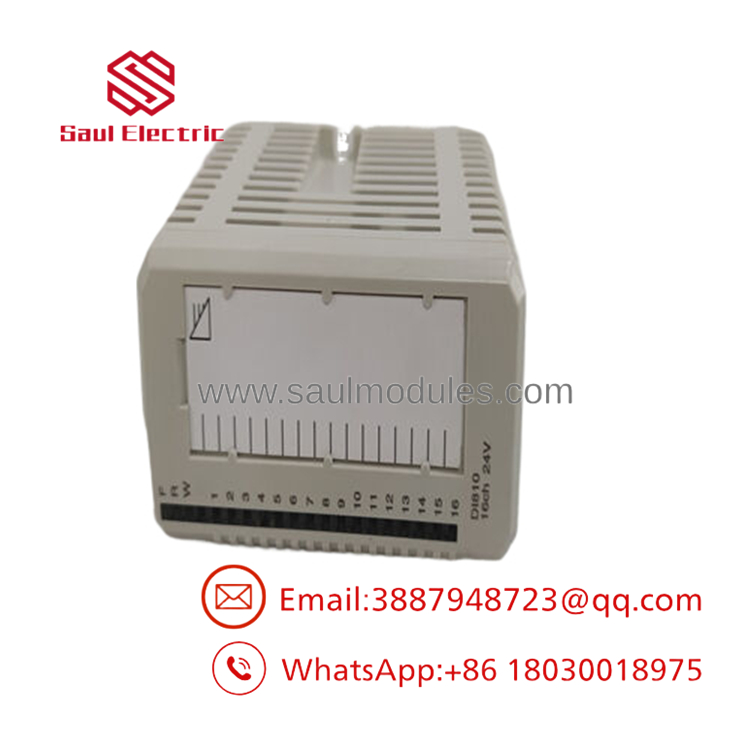
- DI810
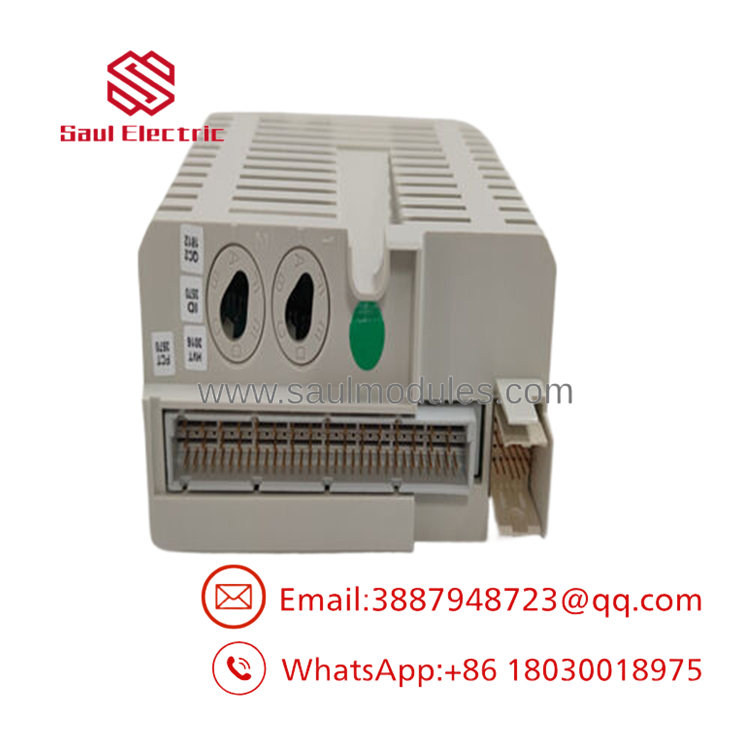
- DI810
Installation & Configuration Guide
Stage 1: Pre-Installation (Prep & Safety)
- Apply Lock-Out/Tag-Out (LOTO).
- Isolate control and field power.
- Wear a grounded ESD wrist strap.
- Photograph:
- MTU wiring
- Channel assignments
- Cabinet labeling
- Adjacent I/O modules
- Verify the replacement module part number and MTU compatibility.
Stage 2: Removal
- Disconnect field wiring only if required by the selected MTU.
- Release the module locking mechanism.
- Remove the module vertically without twisting.
- Inspect the MTU connector for contamination or mechanical damage.
Stage 3: Installation (Clone & Seat)
- Verify the correct MTU type.
- Insert the DI810 fully into the MTU until locked.
- Confirm secure mechanical engagement.
- Restore field wiring if disconnected.
- Verify channel identification before energizing.
Stage 4: Power-On & Testing
- Restore system power.
- Verify the RUN LED indicates normal operation.
- Confirm the FAULT LED remains off.
- Check process voltage supervision.
- Validate all 16 input channels from the controller diagnostics.
- Confirm field devices change state correctly before returning the system to service.
Firmware/Software Versions & Upgrade Notes
- The DI810 contains minimal embedded firmware and normally requires no firmware upgrade.
- Verify the controller firmware supports the installed S800 I/O revision before commissioning.
- Confirm Control Builder or System 800xA hardware libraries match the installed hardware revision.
- Avoid changing controller firmware during an emergency module replacement unless the complete I/O configuration has been validated.
- Back up controller configuration, I/O assignments, and engineering databases before maintenance.
- Verify MTU compatibility whenever replacing older hardware revisions.
Frequently Asked Questions (FAQ)
Q1. Is this module genuinely new?
Yes. This is a New Original / New Surplus ABB module. It is not used, repaired, or refurbished. Each module undergoes serial number verification, functional testing, electrical inspection, and ESD-safe packaging before shipment.
Q2. Why is New Surplus priced below ABB factory supply but above refurbished modules?
New Surplus inventory is sourced from genuine OEM distribution channels and retains original hardware integrity. Although it typically costs more than refurbished equipment, it eliminates hidden component aging, uncertain repair quality, and shortened service life.
Q3. Should the be stocked as a critical spare?
Yes. For continuous-process industries such as power generation, pharmaceuticals, chemicals, oil and gas, and water treatment, the should be classified as an A-Class critical spare. Maintaining 1–2 on-site units as buffer stock minimizes downtime caused by unexpected I/O failures and reduces the impact of lead time variability.
Q4. Can the be hot-swapped?
Hot-swap capability depends on the controller architecture, MTU type, and plant maintenance procedures. Follow the applicable ABB system documentation and your site’s maintenance policy before replacing the module during operation.
Q5. Will replacing the require PLC program changes?
Normally, no. If the replacement module uses the same hardware revision, channel mapping, and controller configuration, the existing application program remains unchanged.
Q6. What quality verification is completed before shipment?
Every New Surplus completes a documented quality process including:
- OEM serial number verification
- Visual inspection
- Electrical verification
- Input channel functional testing
- ModuleBus communication verification
- LED diagnostic verification
- QC inspector approval
- ESD-safe packaging
- Heavy-duty export shipping preparation
Q7. What inventory strategy provides the lowest Total Cost of Ownership (TCO)?
For facilities operating ABB S800 I/O systems, classify the as a critical operational spare. Maintain 1–2 modules as buffer stock, review lifecycle status annually, consolidate approved suppliers, and use cross-site inventory sharing before placing emergency orders. This approach lowers Total Cost of Ownership (TCO), reduces stock-out risk, and limits excess inventory while maintaining high plant availability.

 Start Chat


