





Description
Product Introduction
The DEIF CSQ-3 is a compact Q96 panel instrument that combines a precision LED synchroscope with an integrated check synchronizing relay. It measures generator and busbar voltage, frequency, and phase angle, then closes a single SPST-NO contact when all programmed conditions are met. Front-panel push-buttons behind a protective foil allow safe setpoint changes without exposing the operator to live voltages.
Unlike pure indication synchroscopes, the CSQ-3 actively issues the close command for the circuit breaker. Programmable phase window, voltage difference, relay delay, and pulse length let the same unit handle a wide range of generator sets. Dead-bus logic is built in for black-start or emergency paralleling. Land and marine versions cover both industrial and shipboard applications.
Key Technical Specifications
| Parameter | Value |
|---|---|
| Accuracy | ±2 electrical degrees |
| Resolution | 10 electrical degrees (36-LED circle) |
| Frequency Range | 40…70 Hz |
| Max Frequency Difference | No limit |
| Phase Window (Δϕ) | ±5…20° (1° steps) or ±10…40° (2° steps) |
| Voltage Difference (ΔU) | ±1…10 % (1 % steps) |
| Relay Delay (tR) | 0…1 s (0.1 s steps) or continuous |
| Pulse Duration (td) | 0…1 s (0.1 s steps) |
| SYNC Output | 1 SPST-NO contact |
| Relay Ratings | AC1: 8 A / 250 V AC; DC1: 8 A / 24 V DC |
| Input Voltage Options | 100–127 V, 220–240 V, 380–415 V, 440–480 V AC |
| Dead-Bus Function | Yes (adjustable offset levels) |
| Operating Temperature | –25 °C to +70 °C |
| Dimensions | 96 × 96 × 76 mm (Q96 DIN) |
| Weight | Approx. 0.40 kg |
| Versions | Land / Marine |
Application Scenarios & The “Trench” Experience
It’s 03:10 and the standby generator must be paralleled to the bus after a utility outage. The old mechanical synchroscope is sticky and the operator is guessing the close point. One bad close can damage the generator or trip the whole plant. You need a reliable LED check synchroscope that shows phase clearly and closes the breaker only when voltage, frequency, and phase are inside safe limits.
- Industrial Generator Paralleling – Standby and prime-power sets – Dead-bus and adjustable phase/voltage windows allow safe black-start and soft paralleling.
- Marine Power Systems – Shipboard generator synchronization – Marine version carries the necessary approvals and system-status optocoupler output.
- Cogeneration / CHP Plants – Grid-tie or island-mode transitions – High harmonic immunity keeps readings stable even with non-linear loads.
- Switchgear & Control Panels – Manual or semi-automatic synchronizing stations – Q96 size and front programming keep the panel clean and operator-safe.
Field Case Study
A Midwest manufacturing plant lost its original mechanical synchroscope during a planned generator test. The replacement CSQ-3 was installed the same afternoon. Operators could see the phase circle clearly under plant lighting, set the phase window to ±10°, and close the breaker cleanly on the first attempt. The dead-bus function later proved useful during a real utility outage, allowing the generator to energize a dead bus without additional logic.
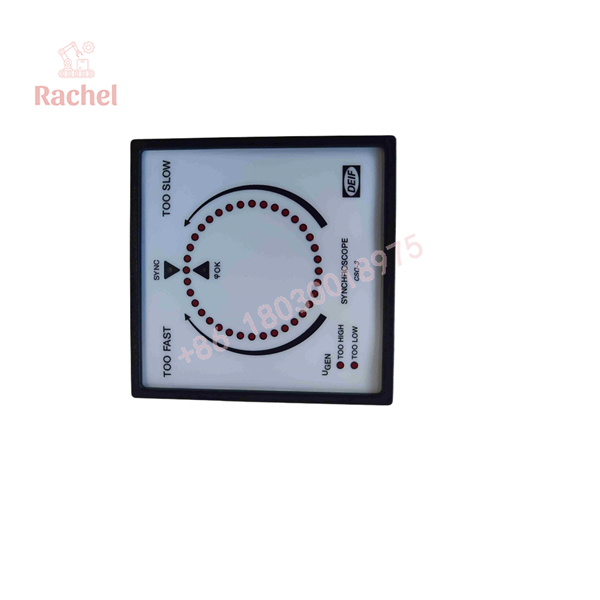
CSQ-3
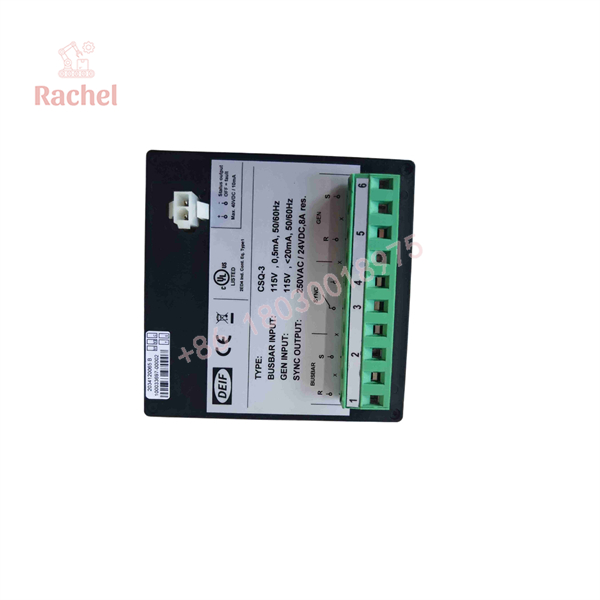
CSQ-3
Transparency SOP: Quality Assurance & Testing
We don’t just ship boxes; every unit is verified against DEIF specifications.
- Inbound Inspection – OEM part-number and version (Land/Marine) verification, front-foil integrity, connector condition, and housing inspection.
- Live Rig Testing – Powered with correct input voltage; LED circle response, phase-window operation, voltage-difference indication, and SYNC relay contact verified.
- Electrical Parameter Checks – Isolation resistance, relay contact resistance, and input voltage range confirmed.
- Firmware / Function Verification – All programmable setpoints cycled and confirmed; dead-bus logic tested.
- Final QC & Packaging – Functional burn-in, version labeling, and protective packaging suitable for industrial or marine shipment.
The Veteran’s Tech Trap Guide
⚠️ Match the voltage range exactly. Ordering a 230 V unit for a 480 V system will destroy the instrument on first power-up. Confirm the UN code (115 V / 230 V / 415 V / 450 V) against the actual bus and generator VT secondary.
❗ Dead-bus settings can surprise you. When enabled, the SYNC relay closes as soon as bus voltage is below the offset and generator voltage is above 80 %. Leave the function off unless you deliberately want black-start capability.
⚠️ Phase window and pulse length interact. A tight phase window combined with a short pulse can miss the close opportunity on slow-slew generators. Start with ±10–15° and 0.5 s pulse, then tighten after observing real behavior.
❗ Front programming is safe only with the foil closed. The push-buttons are behind the protective foil for a reason. Never remove the foil while the unit is powered if you want to keep your fingers away from live terminals.
Frequently Asked Questions (FAQ for Conversion)
Q: Can the CSQ-3 be used for fully automatic synchronizing?
A: It is designed for manual or semi-automatic operation. The SYNC contact can drive a breaker close coil or an external automatic synchronizer enable input, but it does not contain the full automatic speed/voltage matching logic of a dedicated auto-synchronizer.
Q: Land vs Marine version – which do I need?
A: Land version is standard for industrial use. Marine version includes additional system-status optocoupler output and is optimized for shipboard approvals. Confirm the required certification before ordering.
Q: Is the unit still supported by DEIF?
A: Documentation and spare parts remain available. Newer DEIF synchronizing products exist, but the CSQ-3 continues to be used in many existing panels because of its simple Q96 form factor and proven reliability.
Q: What warranty is provided?
A: 12 months from ship date on tested new-surplus units.
Q: Why is this sometimes cheaper than list price?
A: Genuine DEIF units move through surplus and authorized channels. They remain original Danish-built instruments; lower pricing reflects channel dynamics rather than refurbished or non-OEM product.
Q: Does it require external power?
A: No. The CSQ-3 is powered from the measured generator or busbar voltage (selected by the UN range ordered).
Q: Can setpoints be changed while the unit is live?
A: Yes. Push-buttons behind the protective front foil allow programming without opening the switchboard or exposing the operator to hazardous voltages.

 Start Chat


