





Description
Engineering Value
FBM207B is intended for equipment status, permissive, trip, limit-switch, and alarm contacts that do not provide their own external excitation. The module supplies approximately 24 VDC contact-wetting power and evaluates whether each input circuit is open or closed.
Its galvanic isolation helps separate field-input faults from adjacent channels and ground. The module also supports discrete-input, ladder-logic, pulse-count, and sequence-of-events applications, with configurable input filtering for contact bounce and electrical noise.
Technical Specifications
| Parameter | Specification |
|---|---|
| Input function | 24 VDC contact sense |
| Number of channels | 16 |
| Field device | Dry contact, relay contact, or compatible solid-state switch |
| Input wiring | Two-wire input per channel |
| Contact state | Open = off; closed = on |
| Contact-wetting voltage | 24 VDC ±15% |
| Short-circuit current | Approximately 3.2 mA |
| ON-state resistance | 1.0 kΩ maximum |
| OFF-state resistance | 100 kΩ minimum |
| Input isolation | Each channel isolated from every other channel and ground |
| Isolation withstand | 600 VAC for one minute between any channel and ground or between channels |
| Filter options | No filtering, 4, 8, 16, or 32 ms |
| Pulse-count capability | No missing pulses from 0 to 250 Hz, when the applicable pulse-count function is used |
| Communication | Redundant 2 Mbps module Fieldbus |
| Module power | 24 VDC, +5%/−10% redundant input |
| Power consumption | Approximately 4 W |
| Heat dissipation | Approximately 4 W |
| Fieldbus redundancy | Supports single or redundant module configuration |
| Operating temperature | −20 to +70°C, or −4 to +158°F |
| Storage temperature | −40 to +70°C, or −40 to +158°F |
| Relative humidity | 5–95%, noncondensing |
| Altitude | −300 to +3,000 m operating; up to +12,000 m storage |
| Vibration | 0.75 g from 5 to 500 Hz |
| Environmental classification | ISA S71.04 Class G3 harsh environment |
| Approximate mass | 185 g, or 6.5 oz |
| Module dimensions | 102 mm high × 45 mm wide × 104 mm deep; 114 mm high with mounting lugs |
The official FBM207/b/c specification identifies the b version as 24 VDC contact sense, with 16 isolated inputs, 24 VDC ±15% open-circuit voltage, approximately 3.2 mA short-circuit current, and 4 W power consumption.
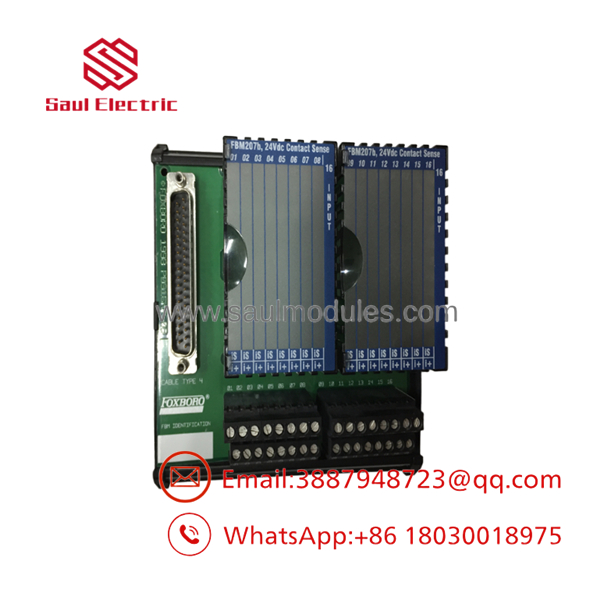
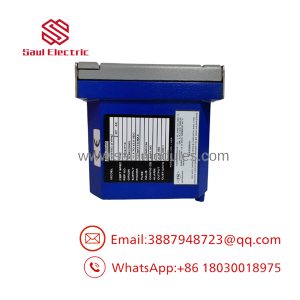
FBM207B P0916JS
Field Application
A compressor station used the FBM207B to monitor sixteen discrete signals, including motor auxiliary contacts, lube-oil pressure switches, seal-gas permissives, local/remote selectors, and valve limit switches. After a module replacement, the control room showed several valves as “closed” even though the field operators confirmed that the valves were open.
The issue was traced to the termination assembly: the replacement wiring had been connected to a voltage-monitor arrangement that expected an external field supply. The FBM207B requires its own 24 VDC contact-wetting circuit. Once the correct contact-sense termination assembly and wiring arrangement were restored, all sixteen statuses responded correctly.
Typical applications include:
- Emergency shutdown valve open/closed limit switches.
- Motor starter run, stop, trip, and local/remote feedback.
- Pump permissive and low-pressure switch monitoring.
- Burner-management relay and flame-permissive status.
- Compressor seal-gas and lube-oil protection contacts.
- Sequence-of-events monitoring for trips and interlocks.
- Mechanical limit switches on dampers, gates, and actuators.
QA and Testing SOP
The P0916JS should be tested as a 24 VDC contact-sense module, not as an externally powered voltage-monitor card:
- Record the full model, part number, revision, serial number, baseplate position, and termination assembly.
- Inspect the module housing, backplane connector, Fieldbus connector, status LEDs, and mounting hardware.
- Apply redundant 24 VDC module power within the specified tolerance.
- Confirm operational status and communication through both Fieldbus paths.
- Verify the contact-wetting voltage at representative input terminals.
- Simulate open and closed contacts on all 16 channels.
- Confirm channel LED indication and correct DCS state transitions.
- Test the configured 4, 8, 16, or 32 ms filter setting.
- Verify pulse-count behavior if the application uses that function.
- Check channel-to-channel and channel-to-ground isolation.
- Confirm that the termination assembly is the 24 VDC contact-sense type.
- Record input state, wetting voltage, filter setting, Fieldbus status, and DCS result for every channel.
The manufacturer states that module and termination-assembly calibration is not required. Functional testing is still necessary to identify failed channels, connector damage, incorrect termination hardware, or configuration errors.
Veteran’s Tech Trap Guide
⚠️ Trap 1: Confusing FBM207B with FBM207.
FBM207B is a 24 VDC contact-sense module. FBM207 is a voltage-monitor version that uses externally powered input circuits. Their termination assemblies and field wiring are different.
⚠️ Trap 2: Using the wrong termination assembly.
The contact-sense version requires the appropriate 24 VDC contact-wetting termination arrangement. A voltage-monitor termination assembly may allow the module to communicate while leaving the field inputs unusable.
⚠️ Trap 3: Mixing FBM207B and FBM207C hardware.
FBM207C is the 48 VDC contact-sense version. It should not be substituted for unless the complete module, termination assembly, wiring, and DCS configuration have been approved for the change.
⚠️ Trap 4: Underestimating contact resistance.
A corroded limit switch or long cable run can produce enough resistance to prevent a reliable ON state. The specification allows 1.0 kΩ maximum for the ON-state and requires at least 100 kΩ for the OFF-state.
PRO TIP: Measure the contact-wetting voltage with the field contact open, then measure closed-state current and resistance. Those three checks quickly separate a failed field switch from a bad module channel.
⚠️ Safety warning: The 600 VAC isolation withstand rating is a test rating, not permission for permanent connection to hazardous voltage. Use only the input voltage and termination arrangement specified for .
Dynamic FAQ
What is the difference between and FBM207?
senses dry contacts or solid-state switches using internally supplied 24 VDC contact-wetting power. FBM207 monitors externally powered DC or AC voltage signals through the appropriate termination assembly.
How many inputs does P0916JS provide?
It provides 16 discrete contact-sense input channels. Emerson’s FlexConnect documentation maps FBM207b/P0916JS to sixteen 24 VDC low-side-sense discrete inputs.
Can P0916JS monitor a 120 VAC status signal?
No. P0916JS is the 24 VDC contact-sense version. A 120 VAC, 125 VDC, or 240 VAC signal requires the appropriate FBM207 voltage-monitor variant and termination assembly.
Does supply the contact voltage?
Yes. The module uses approximately 24 VDC ±15% contact-wetting voltage for the field contacts. The contact circuit is current limited at approximately 3.2 mA.
Can the module be installed redundantly?
Yes. Two modules can be used as a redundant pair with the appropriate redundant adapter, termination arrangement, and Foxboro control blocks. The modules must occupy the specified adjacent odd/even baseplate positions.
How should new-surplus or refurbished P0916JS stock be validated?
Request the complete nameplate, serial number, revision, and termination-assembly details. Testing should demonstrate redundant 24 VDC power-up, Fieldbus communication, contact-wetting voltage, open/closed response on all 16 inputs, input filtering, and channel isolation. The warranty should specify coverage for every channel, communication faults, return freight, and compatibility with the buyer’s Foxboro baseplate and termination hardware.

 Start Chat


