





Description
Engineering Value
FBM207C provides sixteen discrete inputs for valve limit switches, motor feedback, permissives, alarms, and equipment-status contacts. The module supplies the contact-sensing voltage rather than relying on an external field power source for ordinary dry-contact circuits.
Its isolated input architecture helps prevent a ground fault or damaged field circuit from affecting the rest of the input group. Configurable filtering can also suppress contact bounce, relay chatter, and short electrical disturbances in interlock and status circuits.
Technical Specifications
| Parameter | Specification |
|---|---|
| Input function | 48 VDC contact sense |
| Number of channels | 16 |
| Field device | Dry contact, relay contact, or compatible solid-state switch |
| Input wiring | Two-wire input per channel |
| Nominal contact-wetting voltage | 48 VDC |
| Contact-wetting voltage tolerance | Approximately ±15% |
| Short-circuit current | Approximately 3.2 mA |
| ON-state resistance | 1.0 kΩ maximum |
| OFF-state resistance | 100 kΩ minimum |
| Input isolation | Channel-to-channel and channel-to-ground isolation |
| Isolation withstand | 600 VAC for one minute |
| Input filters | No filtering, 4, 8, 16, or 32 ms |
| Pulse-count capability | 0–250 Hz without missing pulses when the applicable function is configured |
| Communication | Redundant 2 Mbps module Fieldbus |
| Module power | 24 VDC, +5%/−10% redundant input |
| Power consumption | Approximately 4 W |
| Heat dissipation | Approximately 4 W |
| Operating temperature | −20 to +70°C, or −4 to +158°F |
| Storage temperature | −40 to +70°C, or −40 to +158°F |
| Relative humidity | 5–95%, noncondensing |
| Environmental classification | ISA S71.04 Class G3 harsh environment |
| Vibration rating | 0.75 g from 5 to 500 Hz |
| Approximate mass | 185 g, or 6.5 oz |
| Approximate dimensions | 102 mm high × 45 mm wide × 104 mm deep; approximately 114 mm high with mounting lugs |
The FBM207 family documentation lists 16 isolated discrete channels, configurable filtering, redundant Fieldbus communication, and approximately 4 W module consumption for the contact-sense versions. The c version uses the higher 48 VDC contact-sense level.
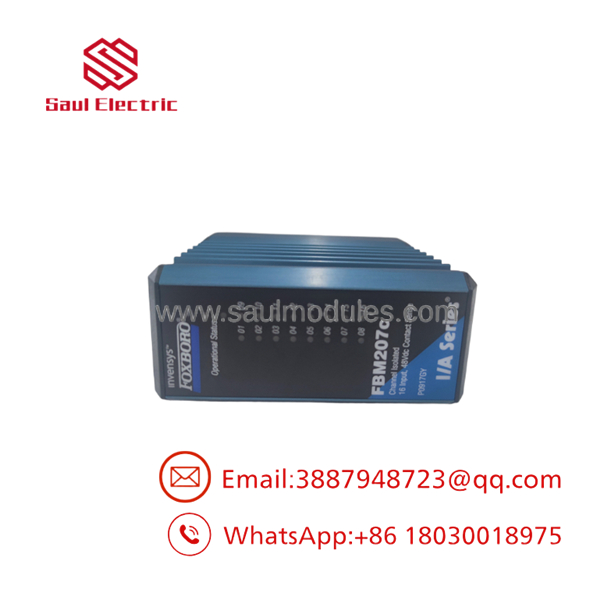
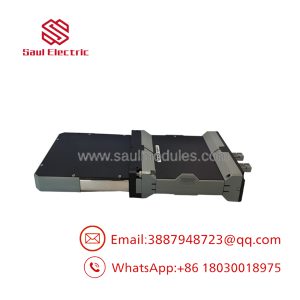
FBM207C P0917GY
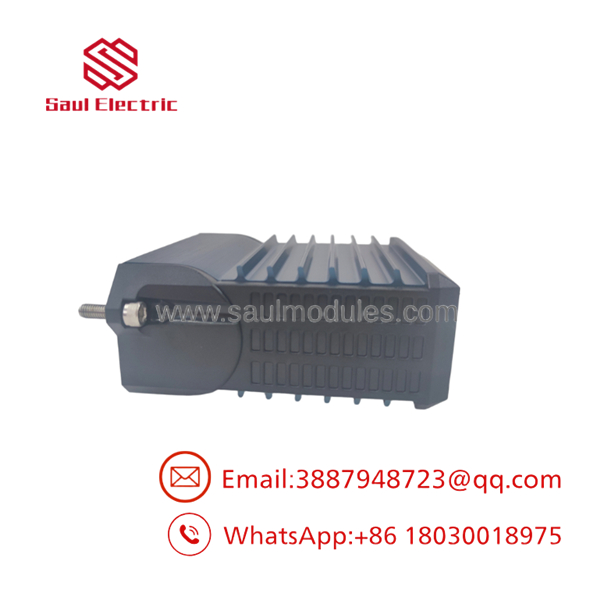
FBM207C P0917GY
Field Application
A power-generation unit used FBM207C inputs for turbine trip relays, breaker auxiliary contacts, emergency-stop feedback, and lube-oil permissives. After a replacement, several inputs remained OFF even when the associated contacts were closed.
A technician measured the field wiring and found that the new module was being supplied through a termination arrangement intended for 24 VDC contact sensing. The 48 VDC contact-sense module did not have the correct field interface. Once the correct termination assembly was installed, the contact-wetting voltage reached the expected level and all sixteen inputs responded normally.
Typical applications include:
- Turbine trip and overspeed relay feedback.
- Medium-voltage breaker auxiliary-contact monitoring.
- Emergency shutdown valve limit-switch feedback.
- Compressor seal-gas and lube-oil permissives.
- Motor starter run, stop, and trip indications.
- Burner-management interlock and flame-permissive circuits.
- Damper and actuator open/closed position switches.
QA and Testing SOP
The FBM207C must be tested as a 48 VDC contact-sense module. Do not validate it with a 24 VDC contact test intended for FBM207B.
- Record the complete part number, revision, serial number, baseplate position, and termination assembly.
- Inspect the module housing, backplane connector, Fieldbus connection, LEDs, and mounting hardware.
- Apply redundant 24 VDC module power within the specified tolerance.
- Confirm module startup and communication through both Fieldbus paths.
- Measure the open-circuit contact-wetting voltage at representative input terminals.
- Simulate open and closed contacts on all sixteen channels.
- Confirm channel LEDs and DCS state changes.
- Test the configured 4, 8, 16, or 32 ms input filter.
- Verify pulse-count operation if the application uses that function.
- Check channel-to-channel and channel-to-ground isolation.
- Confirm that the termination assembly is approved for the 48 VDC contact-sense version.
- Document the measured voltage, contact resistance, filter setting, Fieldbus status, and result for every channel.
A power-up test is not enough. The critical checks are field excitation, correct ON/OFF thresholds, termination compatibility, and reliable state reporting to the DCS.
Veteran’s Tech Trap Guide
⚠️ Trap 1: Confusing FBM207C with FBM207B.
FBM207B is the 24 VDC contact-sense version. FBM207C is the 48 VDC version. Both have 16 channels, but the field excitation and termination requirements are different.
⚠️ Trap 2: Using an externally powered voltage-monitor termination assembly.
FBM207C contact-sense inputs are not wired like FBM207 voltage-monitor inputs. A termination mismatch can produce inactive channels even when the module communicates normally.
⚠️ Trap 3: Assuming 48 VDC means 120/240 V compatible.
is intended for the 48 VDC contact-sense configuration. Do not connect 120 VAC, 125 VDC, or 240 VAC signals unless the exact module and termination assembly are specifically rated for that voltage.
⚠️ Trap 4: Forgetting solid-state switch leakage.
Some proximity switches and electronic relay outputs do not behave like dry contacts. Check OFF-state leakage, polarity, and minimum switching current before connecting them.
PRO TIP: Measure the open-circuit voltage and closed-contact current with the actual termination assembly installed. Bench testing the module without the TA can hide a wiring or interface mismatch.
⚠️ Safety warning: The 600 VAC isolation withstand value is a short-duration test specification, not a normal operating allowance. Follow the voltage rating, wiring method, and hazardous-area requirements shown for the exact hardware combination.
Dynamic FAQ
What is the main function of P0917GY?
It senses 16 discrete 48 VDC contact inputs and transmits their ON/OFF states to the Foxboro I/A Series DCS.
How does differ from FBM207B?
FBM207B uses approximately 24 VDC contact-wetting voltage, while uses approximately 48 VDC. The modules require matching termination arrangements and should not be substituted without checking the field wiring and system configuration.
Can P0917GY accept a 4–20 mA signal?
No. It is a discrete contact-sense input module. It does not measure continuous analog current or voltage signals.
Can it monitor externally powered 120 VAC or 125 VDC signals?
Not as the standard 48 VDC contact-sense configuration. Verify the exact hardware and termination assembly before connecting any externally powered voltage signal. A separate FBM207 voltage-monitor arrangement may be required.
Is the module suitable for sequence-of-events applications?
It can support sequence-of-events and related discrete-input functions when the installed Foxboro software, application block, filter settings, and Fieldbus configuration support them. The input filter must be selected carefully because longer filtering can suppress short events.
How should new-surplus or refurbished P0917GY stock be verified?
Request nameplate and serial-number photographs, revision information, termination-assembly identification, and a functional test report. Testing should show 48 VDC contact-wetting voltage, open/closed response on all 16 inputs, channel indication, Fieldbus communication, input filtering, and isolation checks. The warranty should specify coverage for all input channels, communication faults, return freight, and compatibility with the buyer’s Foxboro baseplate.

 Start Chat


