





Description
Product Introduction
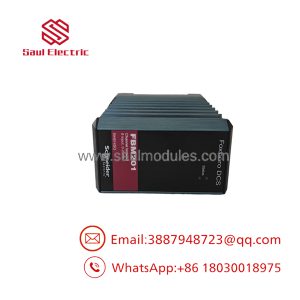
The Foxboro FBM217 (Part Number P0917JW) is a high-density, 32-channel discrete input Fieldbus Module engineered for Foxboro I/A Series and EcoStruxure DCS platforms. Designed for applications requiring extensive binary state monitoring within a compact cabinet footprint, the FBM217 doubles the channel density of standard 16-channel cards, allowing engineers to maximize rack utilization on 200 Series baseplates.
Built to process high-volume digital signals—such as motor auxiliary status, valve limit switch feeds, panel pushbuttons, and trip interlocks—the FBM217 executes onboard sequence-of-events (SOE) timestamping, configurable digital filtering, and ladder logic processing. High-grade optical isolation buffers host baseplate backplane electronics against field voltage surges, ground loops, and electrical noise.
Key Technical Specifications
| Parameter | Value |
| Manufacturer | Foxboro (Invensys / Schneider Electric) |
| Part Number | FBM217 / P0917JW (Base card: P0916JW) |
| Series | Foxboro 200 Series Subsystem |
| Input Channels | 32 discrete input channels (Group Isolated) |
| Input Configurations | External DC Voltage Monitor or Contact Sense (via matching TA) |
| Isolation Voltage | 1500V AC channel-to-bus optical isolation |
| Power Dissipation | 3.5W maximum from baseplate power rails |
| Mounting | Foxboro 200 Series DIN-rail baseplate (P0926KE or equivalent) |
| Operating Temp Range | -20°C to +70°C (-4°F to +158°F) |
Application Scenarios & The “Trench” Experience
The Trench Story
It is 01:25 AM during a full-plant turnaround at a power generation facility. The main control operator notices that an entire bank of 16 breaker status indicators on a high-voltage switchgear panel went offline simultaneously on the DCS graphics. The breaker contacts were physically toggling, but Channel 17 through 32 on a high-density input card stopped updating, stalling the sequence-of-events recorder. Maintenance traced the issue to a blown front-end optical isolator bank on an aging FBM217 module. Swapping the card with a bench-verified FBM217 (P0917JW) unit restored all 32 contact status loops instantly, allowing the electrical team to complete breaker interlock checks ahead of schedule.
Target Application Scenarios
- High-Density Switchgear & MCC Monitoring: Captures run, stop, fault, and trip auxiliary contact states across large motor banks and breaker panels.
- Large Valve Manifold Monitoring: Reads open/close limit switch feedback from extensive pneumatic and hydraulic valve nests.
- Central Safety & Interlock Panels: Processes high-channel-count ESD pushbuttons, gas detection trips, and cabinet door limit switches into DCS logic blocks.
Field Case Study
A chemical processing facility in Ohio experienced channel group dropouts on 32 vessel agitator status lines connected to a Foxboro 200 Series DIN-rail baseplate. Troubleshooting identified internal bus buffer degradation on the installed module. A pre-tested replacement module was dispatched overnight. The site instrument technician placed the monitoring blocks into manual bypass, hot-swapped the card on the live baseplate, and restored 100% signal scanning within 15 minutes.
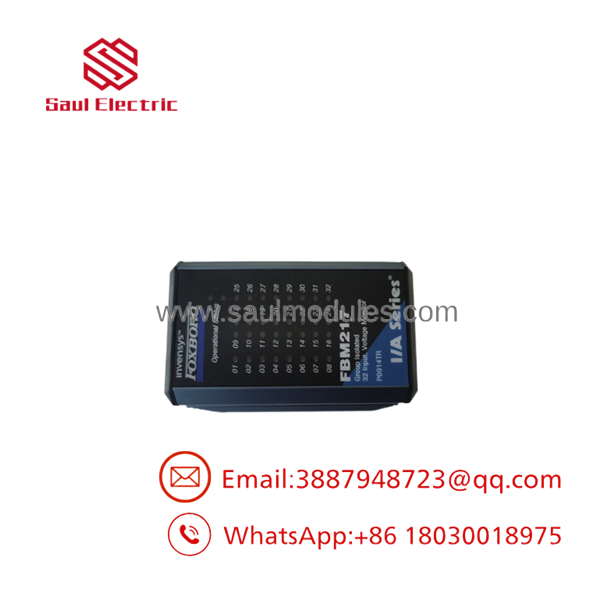
FBM217
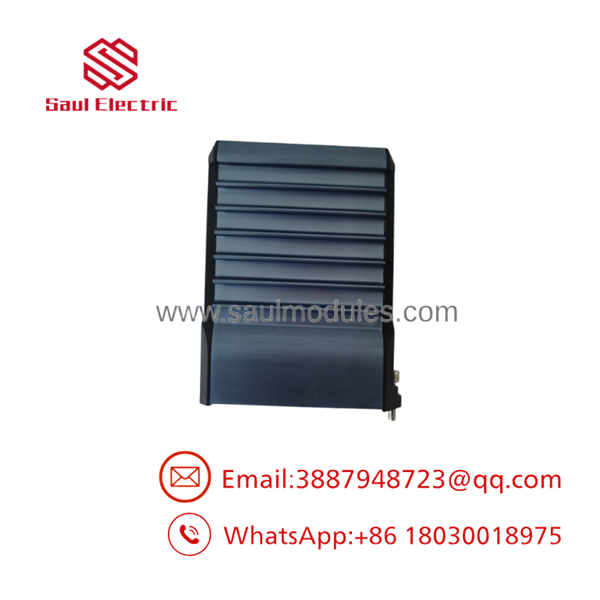
FBM217
Transparency SOP: Quality Assurance & Testing
We don’t just ship boxes; we test them on actual Foxboro 200 Series racks. Every / P0917JW module undergoes a strict 5-stage workbench validation process prior to dispatch:
- Inbound Visual & Mechanical Inspection: Inspection under high magnification to check PCB trace integrity, edge-connector gold plating, housing latch mechanisms, and inspect for thermal stress.
- Cold Power Rail Diagnostics: Resistance checks across internal bus rails, power conversion circuitry, and optocoupler stages to rule out hidden shorts or degraded protection diodes.
- Live Baseplate Bus Handshake: Module is slotted into a live Foxboro 200 Series baseplate connected to a Control Processor to verify bus address recognition, module handshake, and proper LED status routines.
- 32-Channel High-Density State Test: Precision signal simulators toggle all 32 input channels simultaneously across open and closed states. We verify rapid logic state transition, software timestamping, and input status LED synchronization in Foxboro I/A system software.
- Anti-Static ESD Packaging: Cleared modules are solvent-cleaned, thoroughly dried, and sealed in heavy-duty anti-static ESD shielding bags prior to custom foam packaging.
The Veteran’s Tech Trap Guide
- ⚠️ Do Not Confuse (32-Channel) with FBM207 (16-Channel)!
While both sit in standard 200 Series baseplate slots, the uses a high-density 32-channel Termination Assembly (TA) connection. Trying to plug a 16-channel cable harness or TA into an slot will leave half your channels unassigned or fail database software checks.
- ❗ Verify Termination Assembly (TA) Power Sourcing.
Depending on whether your field wiring uses external DC voltage monitoring or dry contact sensing, ensure you match the with the correct high-density Termination Assembly (such as P0917JY or P0917JX). Wiring external field voltage into a dry-contact TA configuration can damage channel optocouplers.
- ⚠️ Group Isolation vs. Channel-to-Channel Isolation.
Because the crams 32 channels into a single module, channels are isolated in groups rather than individually per channel. Ensure your field wiring commons match the isolation group boundaries specified in Foxboro wiring guidelines to prevent unintended ground loops between field devices.
- ❗ Bypass Active Logic Before Hot-Swapping.
While Foxboro 200 Series baseplates fully support Live Insertion and Removal (Hot Swap), pulling an module forces all 32 connected discrete channels to a “BAD” status simultaneously, which will trigger automated system trips if safety interlock blocks aren’t bypassed first.
Frequently Asked Questions (FAQ)
Q: Can I hot-swap the Foxboro module while the baseplate is powered?
A: Yes, Foxboro 200 Series baseplates support Hot Swap (Live Insertion and Removal). However, pulling the module forces all 32 connected discrete channels to “BAD” status in the DCS. Place all affected control, alarm, and safety interlock blocks in Manual or Bypass mode prior to extraction.
Q: What is the exact difference between part numbers and P0917JW?
A: “” is the functional model designation used in DCS system engineering, while “P0917JW” is the exact Foxboro hardware part number stamped on the physical module enclosure and circuit board assembly. They refer to the exact same physical product.
Q: Does the supply internal contact wetting power?
A: Contact wetting power availability depends on the specific Termination Assembly (TA) connected to the . Certain TAs provide internal 24V DC loop power for dry field contacts, while others are designed for external DC voltage monitoring.
Q: What warranty covers these pre-tested modules?
A: Every () module sold includes a full 12-Month Functional Warranty. If the card experiences hardware failure under normal operating parameters within 365 days, we provide an immediate unit replacement or full credit.
Q: Why buy pre-tested surplus stock instead of ordering directly from Schneider Electric?
A: Factory lead times for high-density Foxboro 200 Series I/O hardware can stretch into weeks or months, and factory list pricing for mature hardware is high. Pre-tested surplus stock allows you to restore critical plant interlocks and high-density monitoring immediately at a fraction of the cost.

 Start Chat


