





Description
Product Introduction
The GE DS200DSFBG1A is a Driver Shunt Feedback Board (DSFB) developed for General Electric Speedtronic Mark V gas, steam, and wind turbine control systems, as well as GE industrial drive and excitation cabinets. Positioned at the power conversion interface, the board translates high-current shunt signals and thyristor/SCR states into isolated, noise-free feedback data for the main drive or turbine control processors.
Constructed with isolation transformers, high-speed op-amps, and protective varistors, the DS200DSFBG1A continuously monitors bridge current trajectories. It provides hardware-level trip response against sudden current surges or instantaneous rate-of-change spikes (\frac{di}{dt}), protecting power electronics before overcurrent conditions reach damaging thresholds.
Key Technical Specifications
| Parameter | Specification / Value |
| Manufacturer | General Electric (GE) |
| System Architecture | Speedtronic Mark V & Industrial EX2000 / Drive Systems |
| Board Functional Acronym | DSFB (Driver / Shunt Feedback Board) |
| Primary Function | DC/AC shunt current sensing, driver signal isolation, and overcurrent fault generation |
| Fault Trip Thresholds | • IOC (Internal Overcurrent): Triggers when current exceeds 250% rated current
• DI/DT Fault: Triggers on step changes \ge 100\% in rated shunt current |
| Onboard Isolation | Integrated isolation transformer and optoelectronic barrier paths |
| Connection Hardware | Ribbon cable headers, stab-on spade connectors, and ringed conductive eyelets |
| Form Factor | Full-size DS200 board profile with perimeter guide channels for card stiffeners |
| Operating Temperature | -30°C to +65°C Industrial Extended Range |
Application Scenarios & The “Trench” Experience
The Trench Story
During a rapid load-shedding test on a Mark V-controlled steam turbine exciter, the main drive trips on an instantaneous “Bridge Current Imbalance / IOC Fault”. Field technicians confirm that the main power SCRs and physical shunts are completely healthy, yet the drive processor reads erratic current spikes. Troubleshooting reveals that thermal drift on the original DSFB board’s differential sense amplifier caused zero-point offset errors, misinterpreting normal current ramps as an overcurrent trip. Installing a pre-tested GE DS200DSFBG1A replacement module and ensuring firm contact on the gate/emitter eyelets restores accurate current telemetry, allowing the unit to resume base-load operation.
Industrial Applications
- Speedtronic Mark V Turbine Controls: Monitoring exciter bridge and turning-gear motor current loops in power plants.
- Industrial DC Motor Drives: Sensing armature and field current feedback in heavy steel rolling mills and mining hoist drives.
- Generator Static Excitation (EX2000): Isolating shunt feedback signals in high-output static exciter field regulators.
Transparency SOP: Quality Assurance & Testing
Every legacy DS200DSFBG1A module undergoes a rigorous, multi-stage reconditioning and dynamic current validation protocol before dispatch:
- Inbound Visual & Eyelet Audit: Microscopic inspection under magnification for thermal discoloration, trace delamination, capacitor leakage, and physical condition of conductive gate/emitter eyelets.
- Ultrasonic ESD Cleaning: Deep solvent wash to eliminate conductive carbon dust, grease, and industrial residues accumulated over years of enclosure operation.
- Differential Amplifier & Linearity Test: Injecting precision low-millivolt DC/AC reference signals across shunt input channels to verify linear output scaling and zero drift.
- Hardware Trip Circuit Simulation: Exercising onboard trip comparators to confirm rapid lockout execution during simulated 250% IOC and step-change \frac{di}{dt} events.
- Live System Rack Test: Mounting the module in an active Mark V test bed to confirm backplane signaling, status LED actuation, and stable communication handshaking.
- ESD Packaging: Sealed in static-shielding moisture-barrier bags with individual test certification records.
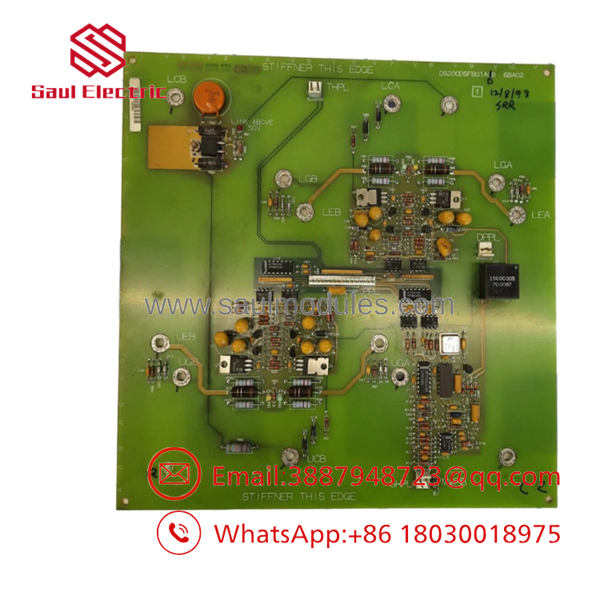
DS200DSFBG1A
The Veteran’s Tech Trap Guide (Crucial Value-Add)
⚠️ 1. Conductive Ringlet & Fastener Seating
The DS200DSFBG1A features conductive ringed eyelets used to attach device gates and emitters directly to the board. Loose mounting screws or oxide buildup on these contact points creates high resistance, leading to erratic firing signals or false gate-driver fault alarms.
Fix: Clean eyelet contact pads with isopropyl alcohol and torque all terminal mounting screws firmly during installation.
❗ 2. Card Stiffener Alignment
Because of its larger PCB footprint, this card relies on plastic or metal edge stiffeners along its margins to prevent board flex during thermal cycling. Operating without stiffeners installed can stress surface-mount components and lead to cracked solder joints.
Fix: Transfer the original structural stiffeners onto the replacement board before sliding it into the cabinet card tracks.
⚠️ 3. Revision & Functional Suffix Parity (G1A vs G1ACB)
Suffix codes (e.g., G1A, G1ACB, G1ADB) indicate specific component upgrades, board artwork revisions, or factory conformal coating variations. While higher revisions are generally backward-compatible, matching the exact part designation ensures hassle-free drop-in replacement.
Fix: Always cross-reference the complete alphanumeric part number stamped on the PCB edge margin prior to replacement.
Frequently Asked Questions (FAQ)
Q: Can I hot-swap the DS200DSFBG1A board while the turbine or drive is running?
A: No. Pulling or inserting a current feedback card live breaks critical sense loops and gate drive paths, which will instantly crash the drive processor, cause SCR misfiring, or trigger an emergency shutdown. Always isolate power before servicing.
Q: What are the primary indicators that a DSFB board has failed?
A: Nuisance trip alarms such as “IOC (Internal Overcurrent)” or “DI/DT Current Fault” when actual motor or exciter current is operating within normal limits.
Q: Does this card require laptop software downloading or chip flashing after replacement?
A: No. The DS200DSFBG1A is a hardware-level feedback conditioning board. Parameter scaling and logic routines reside in the main Mark V control core, making this module a plug-and-play physical replacement.
Q: What is the difference between DS200 and DS215 series boards?
A: DS200 boards represent classic Mark V production designs. DS215 series boards are later-generation drop-in replacements that often feature updated surface-mount ICs while maintaining identical form-factor and backplane pinout compatibility.
Q: What warranty coverage applies to refurbished DS200DSFBG1A stock?
A: Refurbished and fully tested DS200DSFBG1A boards typically include a standard 12-month replacement warranty covering component performance under normal operating conditions.

 Start Chat


