





Description
Product Introduction
The GE DS3800HXRB is a specialized C-Bus Receiver Board engineered for General Electric’s classic Speedtronic Mark IV turbine control racks and related heavy industrial computer enclosures. Operating as a dedicated communication interface, the DS3800HXRB handles backplane data streams, ensuring real-time, low-latency signal reception across internal processor and I/O sub-assemblies.
This board decodes high-frequency bus protocol frames and routes clean digital communications directly to the central processing architecture. Built with dense integrated circuit logic, discrete resistor networks, onboard diagnostic LEDs, and configurable jumper banks, the DS3800HXRB provides the robust noise immunity required in harsh electrical environments like power plants and industrial compressor stations.
Key Technical Specifications
| Parameter | Specification / Value |
| Manufacturer | General Electric (GE) |
| System Architecture | Speedtronic Mark IV / Series 6 / System Drives |
| Board Functional Acronym | HXRB (C-Bus / Communication Receiver Board) |
| Primary Function | High-speed bus signal reception & serial communication isolation |
| IC Density | ~30 Onboard Integrated Circuits (Transceivers, Bus Controllers, Buffers) |
| Diagnostics & Display | 3 Front-edge diagnostic Red LEDs for status/bus-activity monitoring |
| Hardware Configuration | Physical BERG jumpers for bus address setting & impedance termination |
| Connectors | Multi-pin male edge/header connectors for rack bus attachment |
| Operating Temperature | -30°C to +55°C Industrial Extended Range |
| Form Factor | Compact modular Mark IV plug-in card profile |
Application Scenarios & The “Trench” Experience
The Trench Story
It’s 1:00 AM at a combined-cycle generation plant. Gas Turbine #1 triggers a sudden “Communication Bus Timeout / C-Bus Fail” fault across the Mark IV controller rack, dropping the unit offline during a critical power dispatch window. The instrument technician opens the control cabinet and finds one of the red diagnostic LEDs on the DS3800HXRB receiver card unlit, indicating a loss of backplane data framing. Continuous high-temperature thermal cycling inside the cabinet caused a trace driver IC on the aging receiver board to lock up. Swapping in a pre-tested DS3800HXRB replacement board and matching the original jumper configurations immediately restores backplane handshaking, clearing the fault and allowing the turbine to restart without further delay.
Industrial Applications
- Gas & Steam Turbine Control: Managing bus communication paths across Triple Modular Redundant (TMR) or single-core Mark IV turbine control panels.
- Static Excitation Systems: Receiving fast-bus control signals in generator voltage regulation cabinets.
- Heavy Duty VFDs & System Drives: Routing internal communication logic in large industrial drive systems.
- Process Automation Racks: Operating in legacy GE PLC and machine control architectures requiring high-noise-immunity bus receiving.
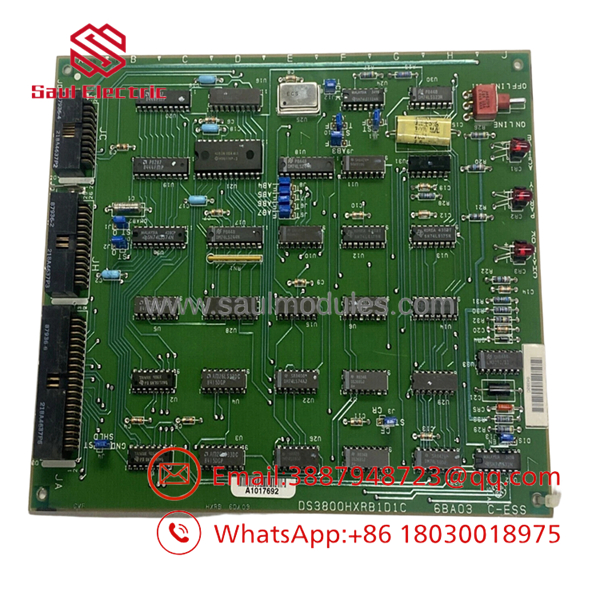
DS3800HXRB
Transparency SOP: Quality Assurance & Testing
Every legacy board goes through a strict multi-step reconditioning and validation protocol prior to shipment:
- Inbound Physical Inspection: Inspection under optical magnification for thermal stress discoloration, hairline trace fractures, damaged jumper pins, and connector pin wear.
- Ultrasonic ESD Cleaning: Deep-cleaning in an anti-static solvent bath to remove airborne oil mist, fine carbon dust, and industrial film accumulated over years of service.
- High-Frequency Bus Signal Testing: Injecting test communication frames across input channels and verifying waveform integrity, rise/fall times, and voltage thresholds using a digital oscilloscope.
- Live Backplane Rack Execution: Installing the card into an operational GE Speedtronic Mark IV test rack under full load to confirm zero bus latency or framing dropouts.
- Thermal Chamber Stress Test: Exercising the board across temperature cycles (-30°C to +55°C) to ensure component stability under severe plant environments.
- Jumper Audit & ESD Packaging: Logging physical BERG jumper settings and sealing the card in vacuum-shielded anti-static ESD packaging.
The Veteran’s Tech Trap Guide (Crucial Value-Add)
⚠️ 1. Bus Termination & Address Jumper Trap
The DS3800HXRB uses onboard BERG jumpers to establish bus line termination resistors and set hardware address offsets. Installing a replacement board without matching the original card’s jumper layout will cause bus reflections, signal distortion, or communication node collisions across the rack.
Fix: Take a high-resolution photo of every jumper block on your failed card before removal, and set all jumpers on the replacement DS3800HXRB card to match exactly before powering up the system.
❗ 2. Male Connector Pin Alignment
The board features multi-pin male header connectors along its edge. Because Mark IV card cages can suffer from tight tolerances, forcing a replacement card into the rack if improperly aligned can bend or break the pins, leading to intermittent connection dropouts.
Fix: Inspect and align card guide rails carefully before applying firm, even pressure along the front edge during insertion.
⚠️ 3. Revision Suffix Parity (e.g., 1B1B, 1D1D)
Suffix codes (e.g., 1B1B, 1C1B, 1D1D) represent specific artwork updates, bus transceiver component revisions, or altered resistor values introduced during manufacturing. While many revisions remain backward-compatible, mixing early and late revisions on the same communication channel can cause subtle bus timing discrepancies.
Fix: Check the full alphanumeric code printed on the PCB side margin to confirm revision parity with your panel drawings.
Frequently Asked Questions (FAQ)
Q: Can I hot-swap the DS3800HXRB card while the Mark IV system is running?
A: No. Removing or inserting a bus communication card while the backplane is energized can corrupt active memory, drop adjacent communication nodes, and instantly trip the turbine. Always de-energize rack power before servicing.
Q: What do the front-edge LEDs indicate during normal operation?
A: The red diagnostic LEDs display power availability and active bus data receiving activity. Solid illumination typically confirms proper power rail levels, while flickering/pulsing indicates active data frame reception depending on the specific rack slot configuration.
Q: Does this board require software flashing or EEPROM configuration?
A: No. The DS3800HXRB is a hardware-level bus receiver module. It contains hardware transceiver circuits, buffers, and jumpers, operating entirely on physical signal decoding without needing software firmware loads.
Q: Why does my control system report “Bus Receiver Fault” immediately after swapping boards?
A: This is almost always caused by mismatched BERG jumper configurations or an unseated connector port in the rack. De-energize the rack, verify that all jumpers match your failed original card line-for-line, and re-seat the card firmly into the rack slot.
Q: What warranty is provided with your surplus and refurbished units?
A: All DS3800HXRB cards are backed by a full 12-month replacement warranty. If a module fails under standard operating conditions within one year, it is replaced directly from stock.

 Start Chat


