





Description
Product Introduction
The GE DS3800NDID1J1D is a Digital Input and Display Driver Board (NDID) designed specifically for GE Speedtronic Mark IV turbine control panels and heavy industrial drive cabinets. Operating as an essential human-machine interface (HMI) link at the rack level, this module CONDITIONS incoming contact closure signals and drives diagnostic LED displays across the control panel front face.
Unlike standard processor cards that operate strictly within backplane logic, the NDID module bridges field contact states (such as pressure switches, limit switches, and trip interlocks) to the processing core. It utilizes optocouplers to isolate delicate backplane digital logic from high-voltage field contact transients, while simultaneously driving status LED matrices so plant operators can visually verify panel health during startup and troubleshooting.
Key Technical Specifications
| Parameter | Specification / Value |
| Manufacturer | General Electric (GE) |
| System Architecture | Speedtronic Mark IV Turbine Control & System Drives |
| Board Functional Acronym | NDID (Digital Input and Display Driver Board) |
| Primary Function | Field contact signal isolation, digital input conditioning, and status LED driving |
| Signal Isolation | Onboard optical isolators (optocouplers) on discrete input channels |
| Backplane Connection | Dual multi-pin gold card-edge connectors for Mark IV rack slot insertion |
| Hardware Configuration | Physical BERG jumpers for contact sensing voltage thresholds & debounce timing |
| Diagnostic Elements | Integrated LED driver arrays for panel status display outputs |
| Board Generation / Prefix | DS3800 Series (Classic full-frame modular PCB architecture) |
| Operating Temperature | -30°C to +60°C Industrial Extended Range |
Application Scenarios & The “Trench” Experience
The Trench Story
It’s 2:15 AM at a gas compressor station. Frame 5 Gas Turbine #2 locks up during its auto-start sequence, throwing an ambiguous “Sequence Interlock Fault” on the operator console. When the instrument crew opens the Mark IV enclosure, they notice several status LEDs on the front diagnostic door are completely dark, even though the field pressure switches are verified closed. Troubleshooting reveals that a localized voltage surge destroyed the optocoupler banks on the aging NDID board, blinding the controller to critical field contact states. Replacing the failed card with a pre-tested DS3800NDID1J1D board—and transferring the physical BERG jumper settings—instantly restores discrete input readings and display indications, allowing the turbine to execute a clean start.
Industrial Applications
- Gas Turbine Sequence Control: Conditioning field interlock contacts (e.g., lube oil pressure switches, fuel valve position limit switches) on GE Frame 5, 6, 7, and 9 units.
- Steam Turbine Trip Logic Interface: Managing contact input status and panel annunciator driver signals in utility power plants.
- Heavy Duty Industrial VFDs: Handling fault contact inputs and operator door LED displays on large industrial drive racks.
- Excitation System Annunciators: Routing alarm contact signals to local LED display driver channels in generator exciter cubicles.
Transparency SOP: Quality Assurance & Testing
We do not simply pull legacy boards out of storage boxes; every module undergoes rigorous dynamic bench testing and validation:
- Inbound Physical Inspection: Detailed visual audit under magnification for thermal trace discoloration, cracked optocoupler bodies, cold solder joints, and card-edge contact wear.
- Ultrasonic ESD Cleaning: Deep solvent wash to remove airborne carbon dust, oil film, and industrial residue built up over decades of enclosure service.
- Optocoupler & Input Channel Isolation Test: Injecting test voltage pulses across all discrete input channels to verify optical isolation barriers and clean switching action without signal leakage.
- Display Driver Output Testing: Exercising display driver lines across full electrical load to confirm LED drive current stability and thermal response of driver transistors.
- Live Mark IV Rack Execution: Installing the card into an active Mark IV test rack to verify backplane bus handshaking, signal timing, and fault-free boot cycles.
- Jumper Audit & ESD Packaging: Documenting all physical BERG jumper settings before vacuum-sealing the card in static-shielding ESD packaging.
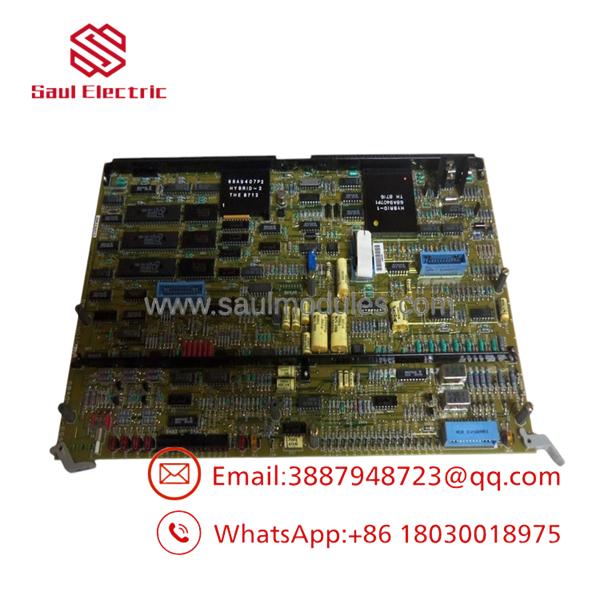
DS3800NDID1J1D
The Veteran’s Tech Trap Guide (Crucial Value-Add)
⚠️ 1. Input Voltage & Debounce BERG Jumpers
The DS3800NDID1J1D features physical BERG jumpers to select input contact sensing voltage levels (e.g., 24VDC vs. 125VDC field contact power) and input filter debounce timing. Installing a replacement board without replicating the jumper settings from your original board will cause false contact bounces, signal dropouts, or input optocoupler burnout.
Fix: Photograph every jumper header on your failed card before removal, and replicate every jumper block position on the replacement NDID card line-for-line.
❗ 2. Card-Edge Connector Maintenance
Legacy Mark IV racks rely on gold-plated edge-connector contacts exposed to years of ambient plant atmosphere. Oxidation or fine dust on these contacts can cause micro-dropouts in digital input channels that mimic field switch failures.
Fix: Clean the card-edge contacts gently with an isopropyl alcohol swab or a clean pencil eraser before inserting the board. Never use abrasive pads like Scotch-Brite, which strip the thin gold plating.
⚠️ 3. Revision Suffix Parity (1J1D)
The trailing suffix 1J1D indicates late-generation artwork revisions, featuring updated noise-filtering caps and upgraded optocouplers compared to earlier 1A or 1B variants. Matching the full alphanumeric code ensures component parity and prevents signal timing mismatch on fast trip loops.
Fix: Cross-reference the complete part number stamped on the edge margin of your physical board before ordering.
Frequently Asked Questions (FAQ)
Q: Can I hot-swap the DS3800NDID1J1D card while the Mark IV panel is under power?
A: No. Removing or inserting an input/display driver board live can cause contact signal spikes across the backplane, potentially triggering false trip signals or damaging adjacent logic modules. Always isolate control power prior to servicing.
Q: What is the most common failure mode on this module?
A: Field voltage surges (such as lightning or ground faults on 125VDC station battery loops) can overstress the input optocouplers. Over time, continuous thermal cycling can also degrade display driver transistors, causing individual panel LEDs to go dark.
Q: Does this card require software flashing or firmware loading after installation?
A: No. The DS3800NDID1J1D is a pure hardware-level interface board. It functions using discrete logic gates, optocouplers, driver transistors, and physical BERG jumpers—no software loading or EEPROM programming is required.
Q: Why are my panel diagnostic LEDs dim or flickering after replacing the board?
A: Flickering or dim LEDs typically point to incorrect input power jumper configurations, an unseated card-edge connector in the rack, or a sagging field contact power supply. Re-verify jumper layouts against your original card and inspect line voltage levels.
Q: What warranty is supplied with your surplus and refurbished stock?
A: Every DS3800NDID1J1D board shipped carries a full 12-month replacement warranty. If a module fails under standard operating conditions within one year of installation, it is replaced directly from stock.

 Start Chat


