





Description
Product Introduction & Engineering Value
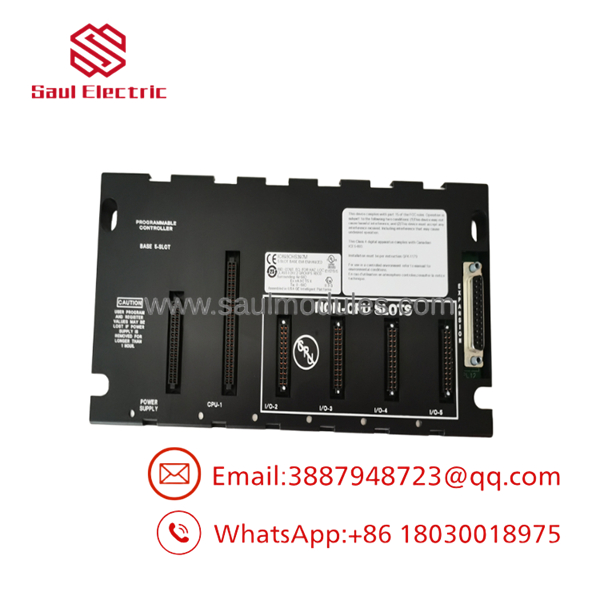
Running out of physical card slots in a control cabinet often leads engineers to panic about costly panel redesigns. The GE Fanuc IC693CHS398 5-slot expansion baseplate provides a straightforward way to increase your Series 90-30 I/O capacity without replacing your existing CPU rack. It interfaces directly with a main CPU baseplate (like an IC693CHS391 or IC693CHS397) via a standard 25-pin bus expansion cable, extending backplane data and logic control seamlessly.
This expansion chassis handles standard discrete, analog, and option modules across its 5 available slots. Designed to accept an independent Series 90-30 power supply card (such as an IC693PWR321 or IC693PWR330), the IC693CHS398 prevents power sag across extended rack lineups while maintaining rigid 35mm DIN-rail or panel-mount structural stability in high-vibration plants.
Technical Specifications
- Number of Slots: 5 total I/O slots (1 dedicated Power Supply slot + 5 module slots)
- Backplane Type: Series 90-30 Expansion Bus (Parallel backplane)
- Connector Type: Right-hand 25-pin female D-sub connector (Expansion Bus IN)
- DIP Switch Settings: 5-position DIP switch bank for setting Rack ID (Racks 1 through 7) and bus termination
- Compatible Power Supplies: IC693PWR321 (120/240VAC), IC693PWR330 (24VDC), IC693PWR322 (24/48VDC)
- Maximum Distance from Main Rack: Up to 50 feet (15 meters) using shielded IC693CBL series expansion cables
- Supported Modules: Standard discrete I/O, analog I/O, temperature control, and option cards (excluding CPU cards)
- Mounting Style: Direct panel mount (4 screws) or standard 35mm DIN-rail mounting
- Dimensions: 10.43″ W x 5.12″ H x 5.59″ D (265mm x 130mm x 142mm with power supply and modules inserted)
- Operating Temperature: 0°C to 60°C (32°F to 140°F)
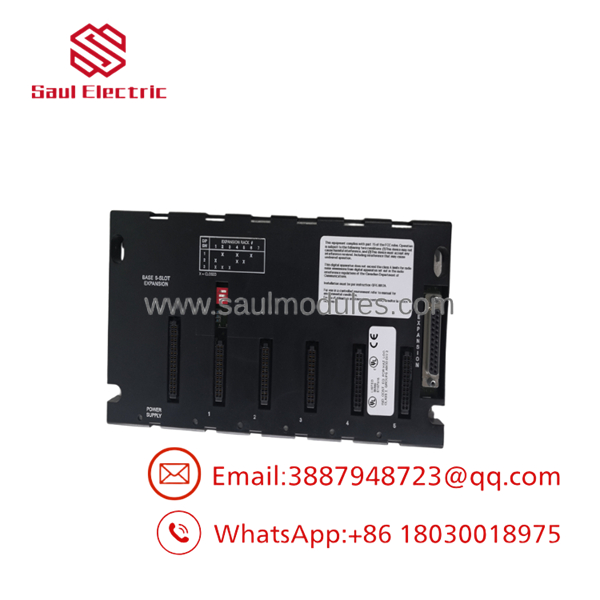
- IC693CHS398
Field Application & The “Trench” Experience
The Extruder Line Expansion Headache
During a mid-week retrofitting project at a plastics compounding plant, engineers needed to add six new thermocouple inputs and four VFD speed-reference channels to an aging Series 90-30 main rack. The existing 10-slot CPU baseplate (IC693CHS391) was completely full. The team briefly considered upgrading the entire system to a PACSystems RX3i platform, but the projected 48-hour downtime window made a total swap impossible.
Instead, the control electrician installed an IC693CHS398 5-slot expansion baseplate directly beneath the main chassis on the sub-panel. They plugged in an IC693PWR321 power supply card, connected a 3-foot IC693CBL300 cable from the main rack’s expansion port to the new chassis, and flipped DIP switch #1 ON to assign the baseplate as Rack 1. Within two hours, the new analog cards were seated, software hardware-configuration was updated, and the extruder line was back up and running.
Core Deployment Scenarios
- Distributed Conveyor Sortation Systems: Mounting a secondary 5-slot rack in an adjacent panel section up to 50 feet away to reduce field wiring runs.
- Grain Elevator Dust Monitoring Skids: Adding extra discrete input channels for belt-misalignment and bearing-temp switches.
- Modular OEM Packaging Equipment: Providing optional plug-and-play I/O expansion slots for higher-end machine configurations.
Transparency SOP: QA & Testing
[1. Mechanical & Pin Inspection] ──> [2. Backplane Bus Continuity] ──> [3. Power Supply Rail Load Test] ──> [4. 5-Slot Communication Loop]
- Mechanical & Visual Audit: We inspect the 25-pin D-sub expansion connector pins for oxidation or bending, check the 5 backplane slot card-edge connectors for broken retention springs, and verify the DIN-rail locking clips.
- Backplane Bus Integrity Check: Ohmmeter testing is conducted across the expansion connector to ensure zero short circuits or open traces across the internal 5V and 24V bus rails.
- Power Supply & Voltage Rail Loading: An
IC693PWR321card is installed and loaded to full rated capacity. We confirm that the +5 VDC and +24 VDC relay power rails supply stable voltage to all 5 slots. - Active 5-Slot Data Communication Test: The baseplate is connected to a live Series 90-30 CPU rack (
CPU374) via anIC693CBL302cable. We populate all 5 slots with discrete and analog I/O modules, cycling inputs/outputs to verify that data addresses map cleanly without bus errors.
The Veteran’s Tech Trap Guide (Crucial Value-Add)
⚠️ TRAP 1: You CANNOT Put a CPU Card in an IC693CHS398 Baseplate! Slot 1 on an IC693CHS398 expansion rack looks visually identical to Slot 1 on a CPU baseplate, but it does not support CPU modules (such as
CPU311,CPU350,CPU374). Expansion racks lack the dedicated CPU backplane address lines. Placing a CPU module into an expansion rack will result in a non-booting system and potential backplane fault codes.
⚠️ TRAP 2: Bus Termination DIP Switch Errors The features a 5-position DIP switch bank on the right-hand side. Switches 1-3 set the Rack ID (1 through 7). However, DIP switch #5 controls bus termination. If this baseplate is the last physical rack on your expansion cable chain, DIP switch #5 MUST be set to ON to engage the internal 120-ohm termination resistor. Leaving it OFF on the end-of-line rack causes signal reflections that intermittently crash the entire expansion bus.
PRO TIP: Calculating Cable Voltage Drop While you can run expansion cables up to 50 feet, remember that the requires its own power supply module installed in the leftmost slot. It does not pull logic power from the main CPU rack across the 25-pin cable. Always account for an additional
IC693PWR321orIC693PWR330module when quoting an expansion build.
Dynamic FAQ
Q: What is the difference between the (5-Slot) and IC693CHS392 (10-Slot) expansion baseplates? A: Functionally, both act as expansion racks for Series 90-30 PLCs. The provides 5 module slots and has a smaller footprint (10.43″ wide), whereas the IC693CHS392 provides 10 module slots and requires more horizontal panel space (17.4″ wide).
Q: Do I need a special cable to connect the to my main CPU rack? A: Yes. You must use a factory-shielded Series 90-30 expansion cable, such as the IC693CBL300 (3 feet / 1 meter), IC693CBL301 (6 feet / 2 meters), or IC693CBL302 (50 feet / 15 meters). Standard 25-pin computer serial cables will not work and lack appropriate shielding.
Q: How many expansion racks can I daisy-chain to a single CPU? A: It depends on your CPU model. High-end Series 90-30 CPUs (like the CPU350 through CPU374) support up to 7 expansion/remote racks total (Rack IDs 1 through 7). Lower-end CPUs (like the CPU311 or CPU323) may only support 1 or 2 expansion racks.
Q: Can I use high-density Option modules (like Ethernet or APM motion modules) in an expansion rack? A: Most standard discrete and analog I/O cards work fine. However, certain high-speed option modules (such as the PCM, ADC, or Ethernet IC693CMM321) have strict backplane timing requirements and must be installed in the main CPU baseplate (IC693CHS391 or CHS397) rather than an expansion rack. Always check the specific module’s manual.
Q: What is your warranty and testing protocol for surplus baseplates? A: Every chassis undergoes a 4-step QA inspection, including full 5-slot communication testing on a live Series 90-30 CPU rack, and is backed by our 12-month full-replacement warranty.

 Start Chat


