





Description
Key Technical Specifications
| Parameter | Value |
| Gas Sensing Principle | Fuel cell type sensor positioned behind a vacuum-resistant, gas-permeable membrane |
| Gas Measurement Range | 0 to 2,000 ppm (Volume/Volume, H_2 equivalent) |
| Gas Accuracy Range | \pm10% of reading \pm25 ppm (H_2 equivalent) |
| Relative Gas Sensitivity | H_2: 100%, CO: 15 \pm 4\%, C_2H_2: 8 \pm 2\%, C_2H_4: 1.5 \pm 0.5\% |
| Moisture Sensing Element | Thin-film capacitive type element immersed in the oil manifold path |
| Moisture Measurement Range | 0 to 100% Relative Humidity (RH) |
| Moisture Baseline Accuracy | \pm2% RH at localized block calibration setpoints |
| Supply Voltage Configuration | Universal internal switch-mode power block: 90–132 V AC or 180–264 V AC, 47–63 Hz |
| Local Interface Display | Built-in backlit graphical LCD (128 \times 64 pixel matrix) with 8-button matrix keypad |
| Integrated Alarm Matrix | 5 x SPDT (Type C) dry contact relays (3 A at 250 V AC / 3 A at 30 V DC resistive loads) |
| Communication Hardware | 1 x RS-232 local diagnostic port, 1 x isolated RS-485 network line |
| Supported Line Protocols | Hydran Native Protocol, Modbus RTU, and DNP 3.0 |
| Enclosure Protection Class | NEMA Type 4X / IP66 weatherproof powder-coated cast aluminum |
| Physical Mounting Link | 1.5-inch NPT male threaded coupling (adapts to 1-inch or 2-inch valves via local hardware) |
Product Introduction
The GE Hydran M2 is a permanently mounted, online dissolved gas analysis (DGA) and moisture monitoring system designed to provide continuous asset diagnostics for medium to large substation transformers. Bolted directly onto a single transformer oil drain valve, this device continuously extracts and evaluates dissolved combustible gas footprints—primarily Hydrogen (H_2) along with Carbon Monoxide (CO), Acetylene (C_2H_2), and Ethylene (C_2H_4)—as well as percentage relative humidity without requiring external oil pumps or complex piping loops.
The monitor functions as an early warning system, tracking daily accumulation rates and absolute concentration thresholds to catch active thermal breakdowns, arcing events, and cellulosic paper degradation early. Armed with onboard computational modeling based on IEEE standards, the Hydran M2 correlates raw DGA metrics, moisture spikes, and optional external sensors (like load current or tank temperature) directly into real-time health indexes, allowing operators to run proactive maintenance schedules instead of handling catastrophic transformer blowouts.
Installation & Configuration Guide
Stage 1: Pre-Installation Preparation (Estimated Time: 30 minutes)
- ⚠️ Safety First: Notify operations and place transformer system auxiliary trip relays into bypass to avoid generating false trip commands during mounting. Ensure your workspace remains free of open flames or arc sources while working on live transformer oil ports.
- Tools Required: 5/32-inch Allen key, heavy adjustable pipe wrench, specialized PTFE thread sealant tape, glass oil sampling syringe with a Luer stopcock, and a digital multimeter.
- Data Backup: Ensure you have downloaded the latest version of GE’s Perception software to your field laptop. Verify the communication parameters and target Modbus or DNP 3.0 node addresses designated for this substation site.
Stage 2: Mounting onto the Valve (Estimated Time: 20 minutes)
- Verify the transformer’s main oil valve is completely shut. Remove any external pipe plugs or blanking plates from the valve body face.
- Clean the female valve threads thoroughly. Wrap the 1.5-inch NPT male threaded pipe fitting of the Hydran M2 unit using professional-grade PTFE sealant tape.
- Thread the 16.5-pound unit into the oil valve by hand to prevent cross-threading. Use your adjustable pipe wrench to turn the mounting coupling until it is tight and the display face is aligned upright.
- ⚠️ Note: Do not apply leverage to the aluminum electronic housing box itself. Only apply force onto the designated steel wrench flats surrounding the NPT threaded base hub.
Stage 3: Bleeding Air and Establishing Flooded Flow (Estimated Time: 15 minutes)
- Crack open the transformer oil valve slowly to pressurize the monitoring block cavity.
- Locate the external manual sampling port screw on the side of the Hydran manifold block. Turn the 5/32-inch Allen screw to bleed air pockets trapped inside the sensing cavity.
- Allow oil to flow out into a waste container until a steady stream with zero bubbles emerges, confirming the internal sensor manifold is entirely flooded with oil. Tighten the Allen screw back to its spec torque.
- Attach your glass syringe to the Luer stopcock to draw an initial baseline manual oil sample for benchmark lab verification.
Stage 4: Power-On & Wiring (Estimated Time: 25 minutes)
- Route the AC power mains, RS-485 communication line, and relay wire connections through the bottom conduit entries. Terminate them at the matching terminal strips inside.
- Switch on the input power. The backlit 128 \times 64 graphic LCD should light up immediately and begin its internal stabilization loop.
- Connect your laptop to the RS-232 serial configuration port, launch Perception software, and synchronize the system clock. Program the specific alarm limits for Gas Alert (Hi), Gas Alarm (HiHi), and Moisture Rate of Change.
- ⚠️ Troubleshooting Note: If the system triggers a permanent “Service Alarm” or “Sensor Temp Fault” on the initial boot sequence, check that the internal heater plate path is drawing current. The internal heating element requires up to 45 minutes to stabilize the sensing cell membrane when deployed in freezing conditions below 0 °C.
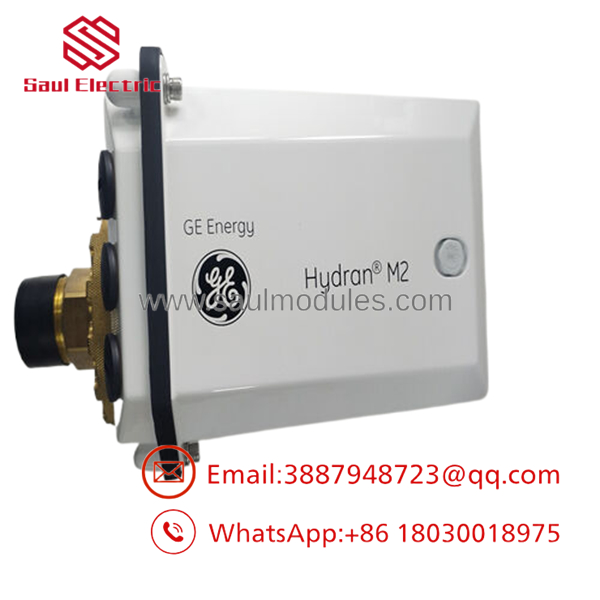
- Hydran M2
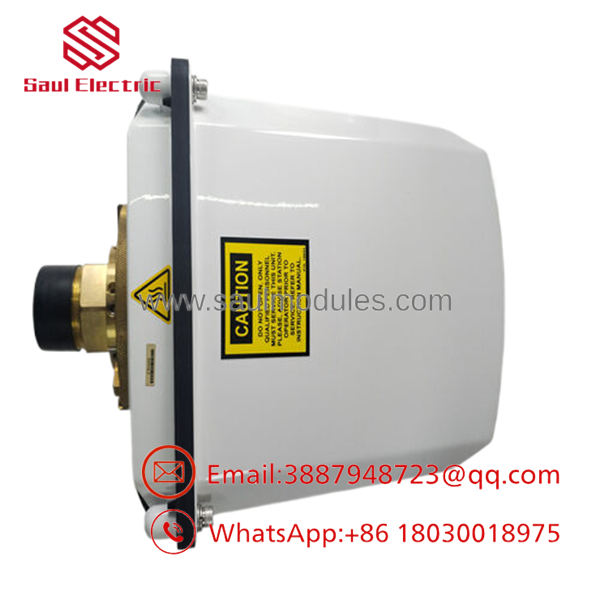
- Hydran M2
Frequently Asked Questions (FAQ)
What is the practical difference between a “Composite Gas” sensor and a “Hydrogen Only” sensor in the Hydran M2?
The traditional Composite Gas sensor uses a broad-spectrum fuel cell that responds 100% to Hydrogen (H_2) but also registers Carbon Monoxide (CO) at roughly 15%, Acetylene (C_2H_2) at 8%, and Ethylene (C_2H_4) at 1.5%. This provides a holistic warning code for multiple failure modes (like paper overheating or arcing). The Hydrogen Only version uses an isolated chemical layout that blocks alternative hydrocarbon gases, tracking purely H_2 levels to avoid cross-gas readings.
Does this device require regular gas cylinder field calibration like a full-scale chromatograph?
No, the Hydran M2 does not utilize any carrier gas bottles, internal pumps, or complex valves, meaning it requires no routine field gas calibration. The fuel cell sensor baseline remains stable over extended deployment cycles. GE recommends pulling a manual oil verification sample from the side Luer port once or twice a year to verify online trends against standard laboratory ASTM D3612 DGA test reports.
Can the Hydran M2 monitor transformers that utilize natural or synthetic ester-based insulating oils?
Yes, newer revisions of the Hydran M2 platform (such as the Mark III and M2-X models) are explicitly configured to support both traditional mineral oils and lower-flammability natural or synthetic ester liquids. When commissioning the unit, you must select the correct oil matrix type via the programming software so the internal calibration scaling curves correctly offset moisture %RH calculations into exact ppm metrics.
What happens if the transformer drops into a deep negative vacuum during processing?
The monitoring assembly features a vacuum-resistant gas extraction membrane structure. Unlike legacy generation oil monitors that tear or delaminate under negative gauge pressure conditions, the Hydran M2 membrane assembly withstands full vacuum variables. This allows processing teams to pull transformer vacuums during oil filtration routines without removing the monitor from the valve line.
How are the analog I/O capabilities expanded on this monitor?
The base board features an internal option slot architecture that accepts up to four auxiliary plug-in cards. Maintenance teams can install combinations of isolated 4–20 mA analog input cards, 4–20 mA analog output cards, or dual digital input cards. These expansion modules allow the M2 to ingest external signals like top-tank oil temperature or load current directly, processing those inputs through onboard mathematical algorithms.

 Start Chat


