





Description
Key Technical Specifications
| Parameter | Value |
| Functional Acronym | PAIC (Analog Input/Output Pack) |
| Subassembly Suffix Code | 336A4940CSP3 (Revision A Execution Profile) |
| Operating System Engine | Embedded QNX real-time operating system platform |
| Total Analog Inputs | 10 Channels (Channels 1–8 configurable; Channels 9–10 dedicated) |
| Input Signal Scaling | Channels 1–8: \pm5 V DC, \pm10 V DC, or 0–20 mA current loop
Channels 9–10: \pm1 mA or 0–20 mA current loop |
| Analog Outputs | 2 Channels: 0–20 mA current loop pathways (PAICH1 configuration) |
| Network Interfaces | 2 x Fully independent 10/100BaseT RJ45 Ethernet ports (ENET1 / ENET2) |
| System Power Input | Nominal 28 V DC (Operating voltage envelope: 18 to 32 V DC; 0.49 A max) |
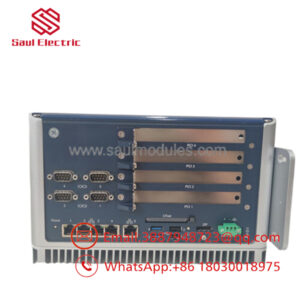
| Local Diagnostics | 4 x Front Faceplate Status LEDs (PWR, ATTN, Link, TxRx) + Infrared serial link |
| Hardware Protection | Hardware watchdog timer, soft-start current limiter, and board temp sensor |
| Compatible Terminal Boards | IS200STAIH1A, IS200STAIH2A, and IS20TBAIH1C (Simplex, Dual, or TMR modes) |
| Ambient Temperature Limits | −30 to +70 °C (−22 to 158 °F) operating thresholds |
Product Introduction
The GE IS220PAICH1A, identified by its subassembly component part number 336A4940CSP3, is a high-performance Analog Input/Output (PAIC) Pack manufactured for General Electric’s legacy PACSystems Mark VIe turbine control and distributed control systems (DCS). Operating as a ruggedized, localized digitization node, this module mounts directly to terminal boards to capture millivolt, voltage, and milliamp metrics from field transmitters before transmitting them directly to master controller racks over redundant Ethernet highways.
Internally, the 336A4940CSP3 module combines an industry-proven processor board running a real-time QNX operating system with a high-accuracy data acquisition board. The unit features 10 specialized analog inputs and 2 dedicated 0–20 mA outputs. Optimized for demanding power station and compressor control environments, the PAIC pack implements protective functions including an incoming soft-start current limiter and localized anti-surge loops to keep field tracking errors from affecting the main 28 V DC system power rail.
Installation & Field Replacement Guide
Stage 1: Pre-Installation Preparation (Estimated Time: 15 minutes)
- ⚠️ Safety First: Confirm with the control room before starting maintenance. Ensure that any automated shutdown or emergency trip loops tied to this analog interface pack are fully bypassed to prevent sudden machinery down-times.
- Tools Required: Grounded static-dissipative ESD wrist strap, small flat-head positioning driver, metric hex sockets, and a calibrated digital multimeter.
- Network Records: Verify the target IP addressing allocation profile and network topology parameters inside your ToolboxST engineering workstation environment.
Stage 2: Extracting the Defective Module (Estimated Time: 10 minutes)
- Affix your ESD wrist strap to a bare metal frame ground point on the control cabinet layout.
- Unplug the 3-pin 28 V DC terminal supply plug from the side of the housing pack.
- Disconnect both RJ45 network cables from the ENET1 and ENET2 ports.
- Back out the long mounting screws that secure the PAIC module body onto its underlying terminal board frame.
- ⚠️ Note: Pull the module straight off the D-sub mounting connector interface on the terminal card. Avoid rocking or angling the module during extraction to prevent bending the high-density DC-37 pin connector contacts on the bottom. Slide the unit directly into an ESD shielding bag.
Stage 3: Seating the New PAIC Module (Estimated Time: 10 minutes)
- Extract the new IS220PAICH1A 336A4940CSP3 module from its anti-static box, checking the integrity of the rear pins.
- Align the bottom DC-37 pin connector socket precisely with the matching male header block on the terminal board assembly (such as the IS200STAIH1A).
- Press firmly on the center of the aluminum enclosure until the pack sits completely flush against the board baseline.
- Tighten the mounting screws to lock the physical and grounding connections.
- Reconnect the ENET1/ENET2 network cables and plug back in the 3-pin power harness.
Stage 4: Power-On & Network Initialization (Estimated Time: 15 minutes)
- Turn on the local 28 V DC distribution breaker to energize the module.
- Watch the front face LED indicators. The PWR LED should glow solid green. If the red ATTN LED lights up or flashes rapidly, the module has failed its initial self-test or lacks correct application code.
- Once the boot cycle completes, the processor will use Dynamic Host Configuration Protocol (DHCP) to request its network parameters via a unique hardware ID read directly from the underlying terminal board.
- Open the ToolboxST software interface. Check that the module shows a normal online configuration status and verify that the digitized analog inputs (Channels 1–10) are tracking correctly against real-time field transmitter values.
- ⚠️ Troubleshooting Note: If the software displays a permanent configuration fault, open the diagnostic buffer. Ensure the hardware part version suffix code (
336A4940CSP3) and revision level in your software configuration matrix match the physical card properties.
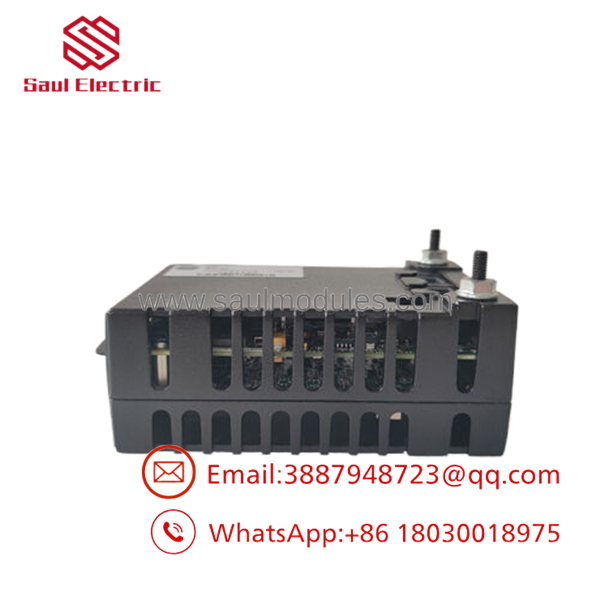
- IS220PAICH1A 336A4940CSP3
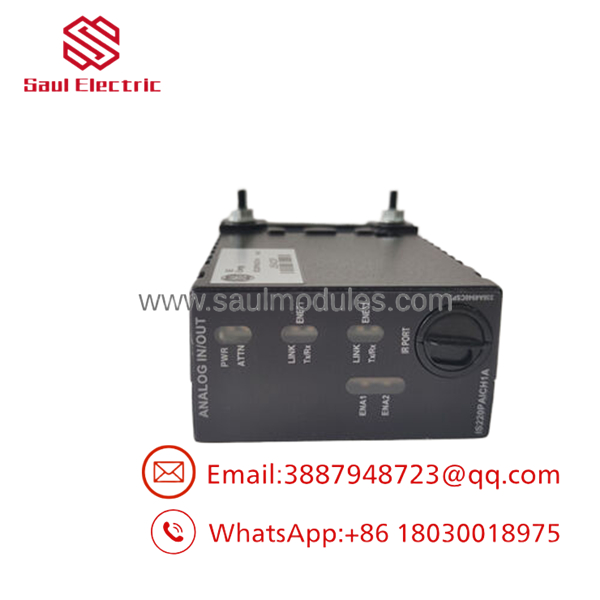
- IS220PAICH1A 336A4940CSP3
Frequently Asked Questions (FAQ)
What is the functional difference between the PAICH1 and PAICH2 variations?
The primary difference lies in the output capacity configuration of the second analog channel. The PAICH1 version (which matches the IS220PAICH1A profile) features two standard 0–20 mA current loop outputs. The alternative PAICH2 configuration adds specialized onboard power-handling hardware to allow a much higher 0–200 mA output range on its first channel, which is typically utilized to drive specialized industrial servo valve positioners.
How does this module handle network failures or communication interruptions?
The 336A4940CSP3 features dual, completely independent 10/100 Ethernet ports (ENET1 and ENET2). When deployed in dual or Triple Modular Redundant (TMR) architectures, both network pathways remain active continuously. If one path fails, breaks, or encounters high packet drops, the pack switches to the secondary line without dropping process cycles or interrupting real-time analog tracking loops.
Do I need to manually assign an IP address to this module when performing a field replacement?
No, manual addressing on the module itself is not required. The PAIC pack utilizes an automated network initialization routine. Upon power-up, it reads the unique electronic ID chip embedded within the local terminal board, then requests its designated IP assignment via DHCP from the master controller. This design allows you to execute a hardware swap without manually configuring communication properties in the field.
Can Channels 9 and 10 be used for standard voltage signaling loops?
No. While Channels 1 through 8 are highly flexible and can be scaled via software configuration for \pm5V, \pm10V, or 0–20 mA loops, Channels 9 and 10 are optimized for low-current tracking. They are designed to support either \pm1 mA or standard 0–20 mA current loops, making them well-suited for specialized sensors like flame detectors or vibration transmitters.
Since the Mark VIe line has been updated, what is the operational condition of this stock?
This module is available as a verified New Original / New Surplus component sourced from climate-controlled warehouse reserves, canceled plant modernization projects, and industrial spare parts pools. We subject every module to physical trace examinations, connector pin checks, and powered network connectivity diagnostics to guarantee out-of-the-box reliability. Each assembly is backed by our full 1-year independent operational warranty.

 Start Chat


