





Description
Product Introduction
The National Instruments PCI-8516 is a dedicated 2-port Local Interconnect Network (LIN) PCI interface card designed for demanding automotive ECU testing, hardware-in-the-loop (HIL) simulation, and production test stands. Built on NI’s hardware-accelerated NI-XNET architecture, the PCI-8516 offloads low-level LIN frame processing and timing directly to its onboard processor, eliminating PC host-controller latency during heavy network traffic.
Unlike basic USB-to-LIN adapters that drop frames during rapid message polling, the PCI-8516 integrates dedicated transceivers (Atmel ATA6620/6625 equivalents) on each port to support LIN 1.3, 2.0, 2.1, 2.2, and SAE J2602 standards. With direct DMA driver integration into LabVIEW, VeriStand, and C/C++, it enables microsecond-level synchronization between LIN bus communication and high-speed data acquisition hardware.
Key Technical Specifications
| Parameter | Specification Value |
| Manufacturer | National Instruments (NI) |
| Model Name | PCI-8516 |
| Bus Connector | Universal PCI (3.3V / 5V signaling, 32-bit) |
| Number of Ports | 2 Independent LIN Ports (DE-9 / DB9 Male Connectors) |
| Baud Rate Range | 2.4 kbps to 20 kbps (per LIN specification) |
| Transceiver Architecture | Integrated onboard LIN transceivers (Atmel ATA6620/6625) |
| Supported Standards | LIN 1.3, 2.0, 2.1, 2.2, and SAE J2602 |
| Onboard Processor | NI-XNET device-driven DMA engine for hardware-level timing |
| External Power Requirement | 8 VDC to 18 VDC required on DB9 VBat pins for LIN bus operation |
| Software Support | NI-XNET Driver, LabVIEW, LabWindows/CVI, C/C++, VeriStand |
Application Scenarios & The “Trench” Experience
Picture this: It’s 2:00 AM in a vehicle validation lab. A automated test bench running a overnight HIL test on a smart door-lock ECU suddenly fails its pass/fail log. The diagnostic software throws a frame timeout error because the PC’s host CPU lagged while servicing background OS updates, causing a missed LIN master header response.
To be honest, situations like this are why test engineers transition from software-polling LIN dongles to the NI PCI-8516. Because the PCI-8516 runs its own onboard NI-XNET execution engine, message scheduling, checksum generation, and response timing happen deterministically on the card itself—completely immune to host computer CPU spikes or Windows background processes.
- Automotive ECU Validation: Testing door modules, seat adjusters, HVAC controls, and mirror actuators on real-time hardware-in-the-loop (HIL) simulators.
- End-of-Line Production Test: High-throughput manufacturing automated test equipment (ATE) for automotive sub-assemblies.
- Bus Monitoring & Logging: Real-time analysis, logging, and playback of LIN frame traffic using LabVIEW or NI Bus Monitor.
- Rest-of-Bus Simulation: Simulating multiple missing LIN slave or master nodes to test a single ECU under isolated conditions.
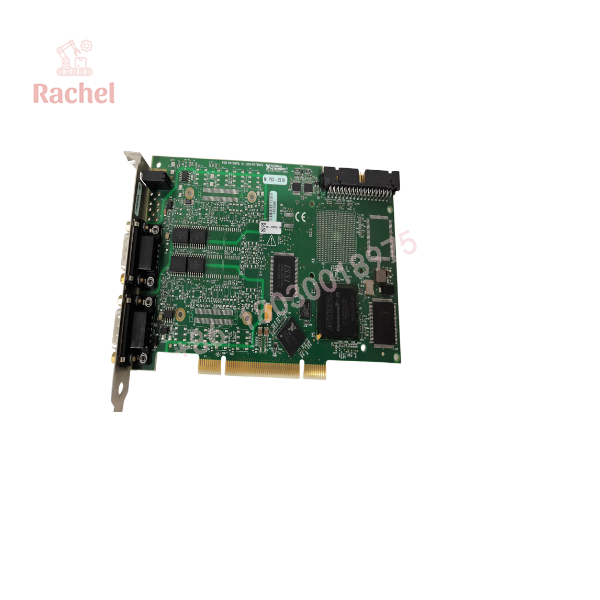
PCI -8516
Transparency SOP: Quality Assurance & Testing
We don’t just ship boxes; we test them on live NI test benches. Every new surplus or refurbished NI PCI-8516 interface card undergoes a mandatory 5-step engineering verification SOP:
- Inbound Visual & Gold-Finger Inspection: Microscopic audit of the PCI edge connector contacts, onboard surface-mount capacitors, and DB9 connector pins for corrosion or wear.
- PCI Bus Enumeration Check: Installing the board into an NI PXI/PCI chassis or IPC test rig to verify clean detection in Windows Device Manager and NI Measurement & Automation Explorer (MAX).
- External VBat Voltage Inject Test: Applying 12 VDC external power to the DB9 VBat pins to verify onboard power-rail isolation and transceiver wake-up states.
- Loopback & Frame Rate Stress Test: Wiring Port 1 to Port 2 in Master/Slave mode, running a continuous NI-XNET frame transmission loop at maximum baud rate (20 kbps) for 2 hours to ensure 0% frame loss or CRC errors.
- Clean & Anti-Static Packaging: Clearing firmware logs, applying protective DB9 dust caps, and sealing the card inside an ESD shielding bag with custom foam packaging.
The Veteran’s Tech Trap Guide (Crucial Value-Add)
If you’re integrating or replacing an NI PCI-8516 board in an active test cell, watch out for these technical traps:
- ⚠️ Missing External VBat Power: Unlike CAN interfaces that can run self-powered, the LIN physical layer requires an external 8V to 18V DC supply applied directly to Pin 9 (VBat) and Pin 3 (COM) of the DB9 connector. If VBat is not connected, the card will enumerate in NI MAX but will fail to transmit or receive any LIN frames!
- ❗ Driver Compatibility (NI-XNET vs. NI-CAN): The PCI-8516 uses the NI-XNET driver framework. If your legacy LabVIEW code was written using the old
ncConfigor NI-CAN API calls, it will not recognize the PCI-8516 without updating the code to NI-XNET VIs or using the NI-XNET Compatibility Layer. - ⚠️ Termination Resistor Configuration: A LIN network requires a 1 kΩ termination resistor for the Master node and 30 kΩ for Slave nodes. The PCI-8516 features software-selectable master termination in NI-XNET. Enabling Master termination on a port already connected to a physical master device will overload the bus pull-up and corrupt communications.
- ❗ PCI Bus Slot Physical Clearance: Ensure the host PC motherboard has a native legacy PCI slot (3.3V/5V universal). Attempting to use low-quality PCIe-to-PCI bridge adapters can introduce bus latency, degrading the deterministic performance of the NI-XNET engine.
Frequently Asked Questions (FAQ)
Q: Can the NI PCI-8516 operate as both a LIN Master and a LIN Slave?A: Yes. Through the NI-XNET software API, each port can be independently configured as either a LIN Master or a LIN Slave node.
Q: Does the PCI-8516 support CAN communication?A: No. The PCI-8516 is a dedicated LIN interface card. If you need a combined CAN/LIN card or CAN-only interface, consider the NI PCI-8512 or PCI-8513 series.
Q: What is the maximum baud rate supported by the PCI-8516?A: It supports the full standard LIN specification speed up to 20 kbps per channel, as well as lower rates like 9.6 kbps and 10.4 kbps.
Q: What cable should I use with the DB9 connectors on the PCI-8516?A: NI offers specific LIN cable harnesses (such as the NI CAN/LIN Cable with integrated power taps), or you can wire a standard DB9 breakout cable using Pin 1 (LIN Bus), Pin 3 (Ground/COM), and Pin 9 (VBat Power).
Q: What warranty coverage comes with this module?A: Every NI PCI-8516 unit—whether New Surplus or OEM Refurbished—comes backed by our full 12-Month Replacement Warranty. If a hardware fault occurs within 365 days under standard operating conditions, we replace it directly from stock.

 Start Chat


