





Description
Product Introduction & Engineering Value
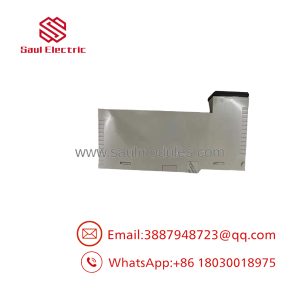
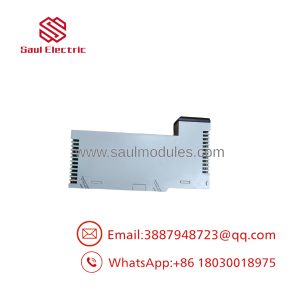
The Schneider Electric 140SAI94000S is a legacy Quantum safety I/O module designed for analog process measurements where the safety system must continuously acquire and diagnose current signals. It provides eight independent analog input channels, 16-bit conversion, channel-to-bus isolation, and internal diagnostics rather than functioning as a conventional non-safety analog input card.
The important procurement issue is lifecycle status. Schneider’s U.S. listing shows the part as discontinued on March 15, 2022, while other Schneider regions show service continuing through December 31, 2029. Schneider currently identifies BMXSAI0410 as the recommended replacement, but this is an X80/M580 safety architecture change rather than a simple Quantum plug-in substitution.
Technical Specifications
| Specification | 140SAI94000S |
|---|---|
| Platform | Modicon Quantum |
| Input type | Analog safety input |
| Number of inputs | 8 |
| Input signal | Current |
| Linear measuring range | 0–25 mA |
| Typical process signal | 4–20 mA |
| Absolute maximum input | 35 mA |
| Resolution | 16 bits |
| Input impedance | 287 Ω |
| Update time | 15 ms |
| Filter | Single-pole low-pass, −3 dB at 15 Hz |
| Accuracy | ±0.3%; ±0.35% of full scale maximum |
| Linearity error | ±2 µA maximum, 0–60°C |
| Channel-to-bus isolation | 1500 VAC for 60 s |
| Channel-to-channel isolation | 500 VAC for 60 s |
| Common-mode rejection | −65 dB at 60 Hz; −70 dB at 50 Hz |
| Bus current | 400 mA |
| Power dissipation | 3.5 W |
| Weight | Approximately 0.45 kg |
| Operating temperature | 0–60°C |
These values are consistent with Schneider’s published product data and the associated datasheet.
Safety Architecture
The 140SAI94000S is more than an eight-channel A/D converter. Schneider’s Quantum safety documentation describes each process-side input as an independent isolated channel acquired by two identical circuits, with internal comparison and diagnostic mechanisms. The architecture monitors the measuring circuitry and performs checks on the analog values before information is passed toward the safety system.
The published product data also identifies TÜV Rheinland SIL2, UL, CSA, and CSA HazLoc certifications.
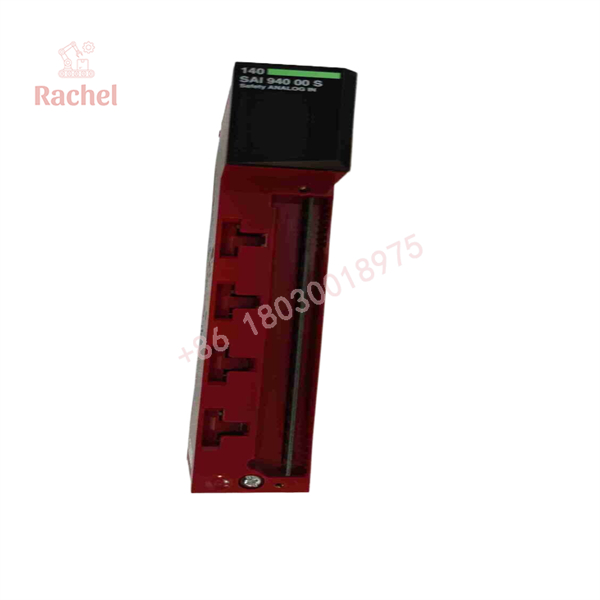
140SAI94000S
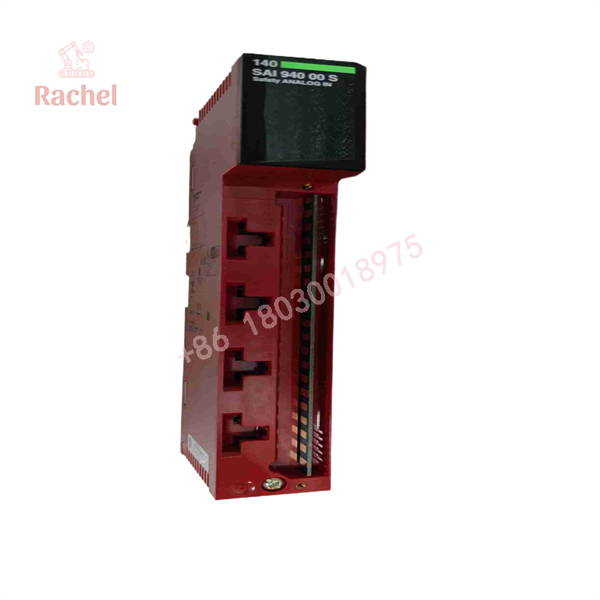
140SAI94000S
Field Application & “Trench” Experience
Example: Compressor Anti-Surge Protection
Consider a legacy compressor train using a Quantum safety controller. Several 4–20 mA transmitters monitor suction pressure, discharge pressure, flow, and temperature. A 140SAI94000S receives these process values for safety-related logic.
During maintenance, one channel begins reporting a value that does not agree with the transmitter’s local display. A common mistake is to immediately replace the transmitter. The better diagnostic sequence is to isolate the problem:
- Verify the transmitter’s loop current with a calibrated meter.
- Check loop resistance and field wiring.
- Compare the measured current against the Quantum input value.
- Check the module’s channel diagnostic indication.
- Compare the affected channel against the redundant measurement path where applicable.
- Substitute a known-good input channel or spare module only after field-side checks.
This approach distinguishes a transmitter problem from a 140SAI94000S channel fault without unnecessarily disturbing a safety loop.
Niche Applications
- Compressor shutdown and anti-surge monitoring — pressure and flow transmitters feeding safety logic.
- Boiler and fired-heater protection — process temperature or pressure measurements used by safety functions.
- Hydrocarbon processing units — analog measurements requiring diagnostic supervision within a legacy Quantum safety architecture.
QA & Testing SOP
For a New Surplus or professionally refurbished 140SAI94000S, procurement should require more than a visual inspection.
Recommended acceptance sequence:
- Part-number verification — confirm the label reads exactly
140SAI94000S. Do not substitute a standard Quantum analog input module merely because its connector and physical format appear similar. - Visual inspection — inspect terminal/connector condition, housing, PCB contamination, corrosion, and evidence of thermal damage.
- Power-up test — verify normal bus communication and absence of system-fault indications.
- Channel test — inject known current values into all eight inputs.
- Calibration verification — test representative points such as 4, 12, and 20 mA and compare the reported values against the calibrated source.
- Diagnostic test — verify channel and fault indications.
- Documentation check — record serial number, condition, test date, and warranty terms.
For a safety I/O module, a supplier’s generic “tested” statement is not sufficient. The test record should identify what was actually injected and measured.
⚠️ Veteran’s Tech Trap Guide
⚠️ Trap 1 — Treating it as an ordinary 4–20 mA card
The 140SAI94000S is a safety analog input module. Its architecture and diagnostic behavior are part of the safety system design. Replacing it with a conventional Quantum analog input module can change the safety function even if the field signal is still 4–20 mA.
⚠️ Trap 2 — Assuming BMXSAI0410 is a drop-in replacement
Schneider recommends BMXSAI0410, but the replacement belongs to the Modicon X80/M580 safety architecture and provides four isolated inputs rather than the 140SAI94000S’s eight inputs.
A migration therefore requires engineering review of rack architecture, I/O addressing, safety configuration, application logic, wiring, and validation.
⚠️ Trap 3 — Ignoring the 287 Ω input impedance
A 287 Ω input impedance matters when multiple devices share a loop or when the transmitter has limited compliance voltage. Before declaring a transmitter defective, calculate the complete loop burden.
PRO TIP: For an existing installation, photograph and document the terminal wiring before removing the module. On legacy safety systems, restoring the exact channel assignment can be more important than simply finding an electrically compatible input card.
Lifecycle & Spare-Inventory Strategy
The lifecycle situation needs regional attention. Schneider’s U.S. product page records the 140SAI94000S as discontinued March 15, 2022, while Schneider Australia and India currently show a December 31, 2029 end-of-service date.
For a plant still operating Quantum safety hardware, this makes the 140SAI94000S a high-criticality spare candidate.
Recommended inventory policy:
- Keep at least one tested spare for every safety-critical application where loss of the module can cause an extended shutdown.
- For plants with multiple identical Quantum safety racks, consider a centralized spare pool after confirming interchangeability.
- Record whether each spare is New Surplus, Refurbished, or Used.
- Preserve original packaging when possible.
- Verify firmware/configuration compatibility before installation.
- Start migration planning well before the remaining service window expires.
- Treat the BMXSAI0410 migration as an engineering project, not a simple purchasing substitution.
Dynamic FAQ
Is the Schneider 140SAI94000S still manufactured?
No, at least in the U.S. Schneider lists it as discontinued on March 15, 2022. Lifecycle dates differ by country; Schneider currently lists later service dates in some other regions.
What is the 140SAI94000S used for?
It is an eight-channel analog safety input module for the Modicon Quantum platform, designed to acquire current-based process signals in safety applications.
Does it support 4–20 mA signals?
Yes. Its published linear measuring range is 0–25 mA, with 4–20 mA being the normal industrial process-signal range for this type of input.
What replaces 140SAI94000S?
Schneider identifies BMXSAI0410 as the recommended replacement. It is an X80 safety analog input module with four isolated inputs, so the migration requires an engineering assessment rather than a direct card-for-card replacement.
Can a New Surplus 140SAI94000S be used in an existing Quantum safety system?
Potentially, provided the exact hardware, safety architecture, application configuration, and installation requirements are compatible. For a safety function, the replacement should be subjected to the plant’s applicable validation and proof-testing procedures.
What warranty should I expect when buying one?
Warranty depends on the seller and condition. Schneider’s product documentation contains its own warranty terms, while secondary-market suppliers may provide their own warranty rather than Schneider factory warranty. For example, one reseller explicitly states that its 12-month warranty is its own and that factory warranty may not apply.
Bottom Line
140SAI94000S is a legacy Schneider Electric Modicon Quantum safety analog input module with 8 isolated 16-bit current inputs, 287 Ω input impedance, 15 ms update time, and internal safety diagnostics. Its key procurement risk is not basic electrical compatibility; it is maintaining the intended safety architecture and validation status of the existing Quantum installation.
For a plant still dependent on Quantum safety I/O, this is a part worth holding as a controlled spare while simultaneously planning the transition to the X80/M580 safety platform.

 Start Chat


