





Description
Product Introduction
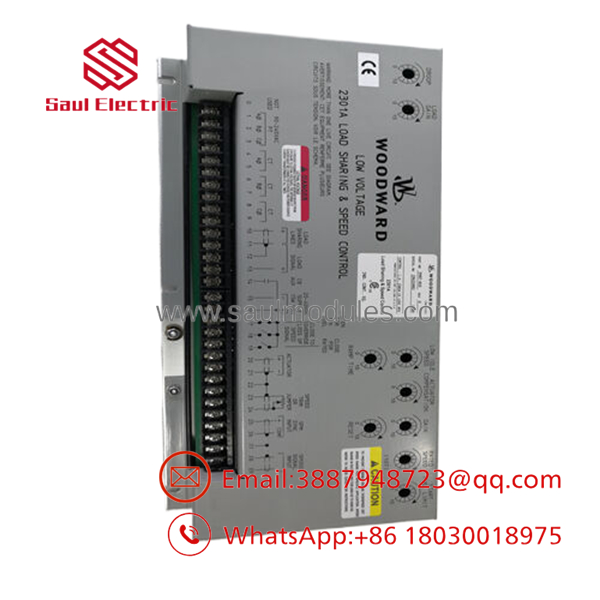
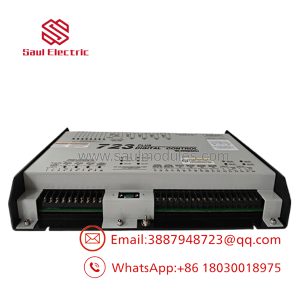
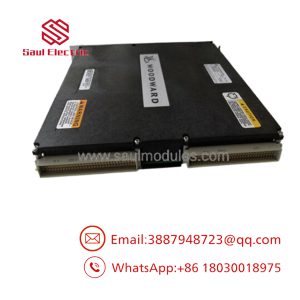
The Woodward 9907-019 is a 2301A Electronic Load Sharing and Speed Control designed for diesel engines, gas engines, steam turbines, and gas turbines driving generators. Its primary purpose is to regulate prime mover speed while maintaining stable load sharing during parallel generator operation.
Unlike a synchronizer, the 9907-019 directly controls the governor actuator. It provides isochronous or droop speed regulation and interfaces with magnetic pickup speed sensors, current transformers, and potential transformers. One thing to watch out for is that this model is reverse-acting. Installing it in a system designed for a forward-acting governor will cause incorrect fuel control behavior.
Key Technical Specifications
| Parameter | Value |
|---|---|
| Manufacturer | Woodward |
| Model | 9907-019 |
| Product Family | 2301A 9907 Series |
| Product Type | Electronic Load Sharing & Speed Control |
| Control Action | Reverse-Acting |
| Supply Voltage | 20–40 VDC |
| Actuator Output | 0–200 mA |
| Actuator Configuration | Single Actuator |
| Speed Control Modes | Isochronous / Droop |
| Speed Input | Magnetic Pickup (MPU) |
| Selectable Speed Ranges | 500–1500, 1000–3000, 2000–6000, 4000–12000 Hz |
| Load Sharing | Supported |
| Deceleration Ramp | Not Included |
| Certification | CE Approved Model |
Application Scenarios & The “Trench” Experience
The engine starts immediately.
Fuel pressure looks normal.
The generator reaches rated voltage.
Then engine speed suddenly races when load changes.
Everyone blames the actuator.
I’ve seen this more than once. The replacement governor wasn’t defective. Someone installed a reverse-acting 9907-019 where the original system required a forward-acting controller. The controller responded exactly as designed—the application simply didn’t match the hardware.
Typical Applications
Power Generation — Standby diesel generators — Maintains constant engine speed and generator frequency during changing electrical loads.
Industrial Cogeneration — Parallel generator systems — Shares active load between multiple generator sets operating on an isolated bus.
Oil & Gas — Gas engine compressor stations — Regulates engine speed while compensating for varying process loads.
Marine Power — Auxiliary generators — Controls reverse-acting fuel systems for shipboard power generation.
Steam Turbine Applications — Industrial turbine drives — Maintains stable turbine speed and load distribution.
Field Replacement Example
A municipal utility replaced a failed governor controller during a scheduled outage. The engine immediately became unstable after startup. Wiring, actuator calibration, and the magnetic pickup all tested correctly. The real problem was simple: a forward-acting controller had been replaced with a 9907-019 reverse-acting unit. Installing the correct controller restored stable speed regulation without changing any field wiring.
- 9907-019
- 9907-019
Transparency SOP: Quality Assurance & Testing
We don’t just ship boxes; we test Woodward governor controls on compatible engine governor test benches whenever practical.
- Inbound Inspection
- Verify Woodward part number and serial number.
- Inspect connectors, enclosure, and adjustment potentiometers.
- Check for corrosion, overheating, or unauthorized repairs.
- Live Rig Testing
- Verify startup operation.
- Simulate magnetic pickup frequency.
- Confirm actuator output response.
- Test load-sharing circuitry.
- Verify reverse-acting operation.
- Electrical Parameter Checks
- Measure supply current.
- Verify 0–200 mA actuator output.
- Test digital inputs and shutdown logic.
- Confirm stable governor response.
- Firmware & Configuration Verification
- Verify hardware identification.
- Inspect internal calibration.
- Record revision details when available.
- Final QC & Anti-static Packaging
- Complete functional inspection.
- Anti-static packaging.
- Shock-resistant shipping.
- Serial-number traceability.
The Veteran’s Tech Trap Guide
⚠️ Never ignore “Forward” versus “Reverse.”
The 9907-019 is a reverse-acting controller. Installing it in a forward-acting fuel system can cause unstable speed control or drive the actuator in the wrong direction.
⚠️ Verify the power supply before installation.
This model requires a 20–40 VDC supply. Don’t assume every 2301A controller uses the same input voltage. Woodward also manufactures high-voltage versions.
❗ Check the magnetic pickup signal first.
Weak or noisy MPU signals often create hunting, overspeed alarms, or unstable frequency. Replacing the controller won’t solve a damaged speed sensor or poor wiring.
⚠️ Record every adjustment before removing the old controller.
Gain, stability, droop, idle speed, rated speed, and load-sharing settings are usually tuned during commissioning. Losing those values can extend startup by several hours.
Frequently Asked Questions (FAQ)
Q1. What is the Woodward 9907-019?
The 9907-019 is a Woodward 2301A Electronic Load Sharing and Speed Control used to regulate engine speed and generator load sharing for diesel engines, gas engines, steam turbines, and gas turbines.
Q2. Is the 9907-019 a reverse-acting controller?
Yes. The 9907-019 is specifically designed as a reverse-acting model with a 0–200 mA actuator output for single-actuator applications.
Q3. Does it support isochronous and droop operation?
Yes. The controller supports both isochronous and droop speed regulation depending on the application and generator operating mode.
Q4. Does the 9907-019 include a deceleration ramp?
No. According to the Woodward 2301A model table, the 9907-019 does not include the optional deceleration ramp feature.
Q5. Can it be hot-swapped?
No. Removing a governor controller while the engine is operating interrupts speed regulation and may result in engine shutdown or an overspeed event. Always isolate the engine before replacement.
Q6. Why is this model still widely used?
Many industrial generators, compressor stations, marine vessels, and turbine packages commissioned decades ago continue to operate reliably with the 2301A platform. Maintaining qualified spare controllers is often more economical than replacing an entire governor system.
Q7. What should be verified before installation?
Confirm the 9907-019 part number, reverse-acting configuration, 20–40 VDC power supply, actuator compatibility, magnetic pickup frequency range, CT/PT wiring, governor tuning parameters, and load-sharing connections. Before returning the engine to service, perform idle-speed verification, rated-speed testing, load acceptance, and parallel operation validation.

 Start Chat


